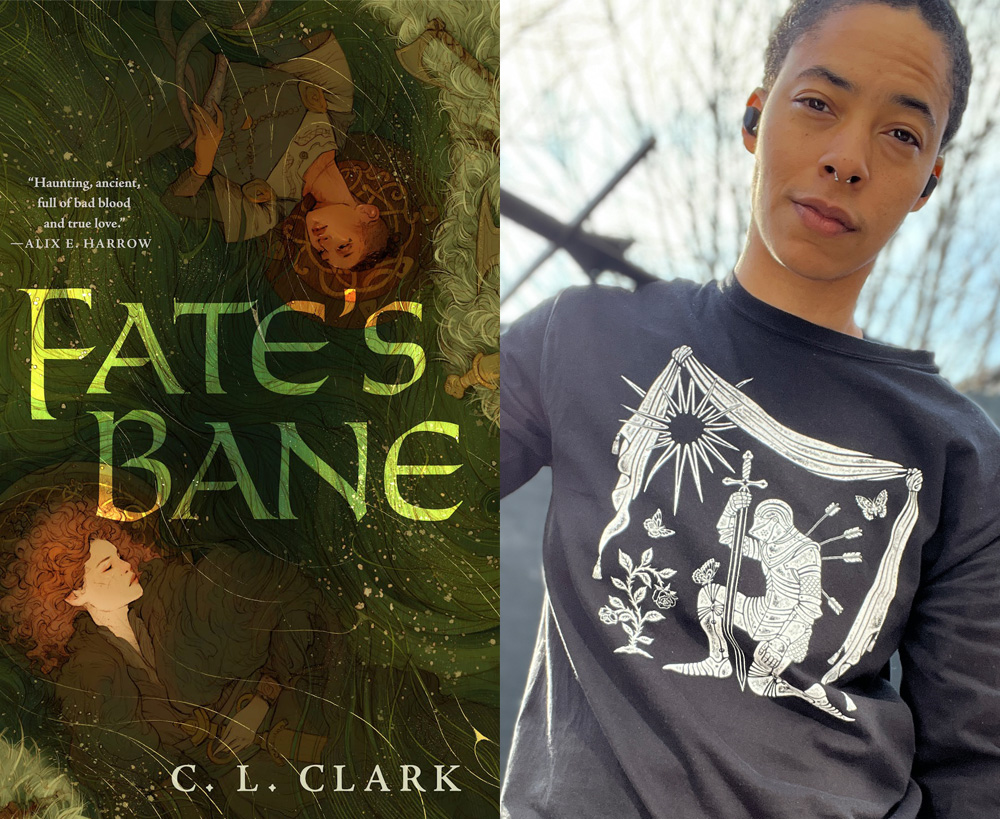
first fell in love with C.L. Clark’s writing through a short story, “You Perfect, Broken Thing,” in Uncanny Magazine. After a bit of binge reading, I’m certain WOW readers will find plenty of inspiration in C.L.’s work!
Before we get to the Q&A, let’s take a peek at C.L.’s bio:
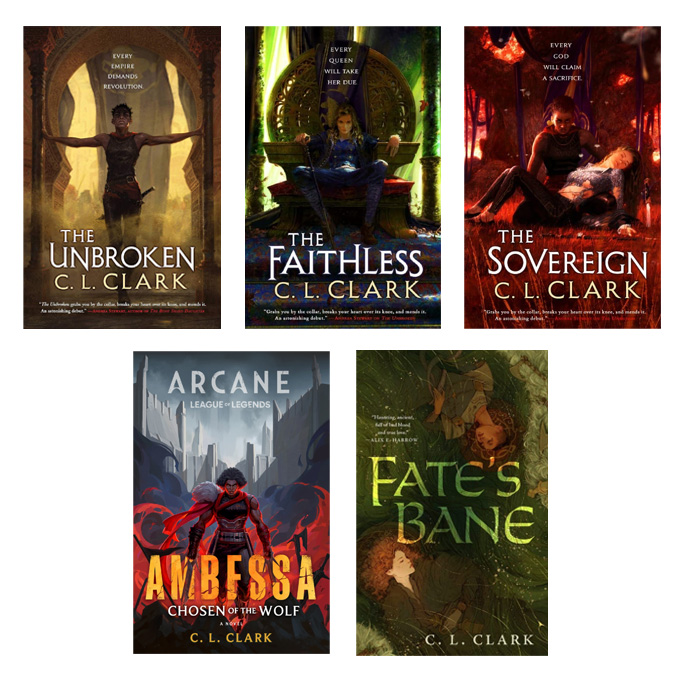
C.L. Clark is the author of the Magic of the Lost trilogy (The Unbroken, The Faithless, and The Sovereign), Ambessa: Chosen of the Wolf, and Fate’s Bane. She graduated from Indiana University’s creative writing MFA and was a 2012 Lambda Literary Fellow. She’s been a personal trainer, an English teacher, and an editor, and is some combination thereof as she travels the world. When she’s not writing or working, she’s learning languages, swinging sword and kettlebells, or reading about war and [post-]colonial history. She’s a former co-editor of the Hugo-nominated and British Fantasy Award-winning PodCastle, and her work has appeared in Uncanny, Beneath Ceaseless Skies, Fantasy Magazine and more.
WOW: Congratulations on your upcoming novella, Fate’s Bane! The book will be released by Tordotcom on September 30. Tell us about it!
C. L.: Thank you so much! Fate’s Bane is about a girl, a young woman, who is given to an enemy clan as ward—a hostage to guarantee her own father’s good behavior. She falls in love with the daughter of her foster father, and when their clans threaten war again, they are caught in the middle, with nothing but their love and a mysterious curse to save them.
I trace some themes that I seem to revisit, now that I think about it—themes of belonging in a home where everyone says you are different; falling in love across boundaries. I was also interested in finding ways to help even when you feel helpless. But really, I prefer readers to read and see what resonates with them. I’ve already seen reviews that pick up on things that I didn’t consciously realize.
WOW: Sounds like a compelling story! And it’s not the only book you have coming out this fall. The final installment of your Magic of the Lost trilogy is also on the way! The first book of trilogy, The Unbroken, was a finalist for the Ignyte Award for Best Adult Novel, the Nebula Award for Best Novel, the Locus Award for Best First Novel, and the British Fantasy Society's Robert Holdstock Award for Best Fantasy Novel. That’s impressive! Can you give us a quick intro to these books?
C. L.: The Unbroken is about Touraine, a conscripted soldier who was taken from her home as a child and raised by the empire. When she and her fellow soldiers are shipped back to that imperial colony to quell a rebellion—well, things get complicated. And when Touraine is pulled into the service of Luca, the cruel, beautiful scholar princess, who’s trying to discover the secrets of the colony’s healing magic, it only gets worse.
The trilogy continues through battlefields and political salons as Touraine and Luca fight for the souls of their nations and the sovereignty of their peoples, all as the magic of the gods rises and demands sacrifices they may not be willing to pay. It also publishes on September 30—it’s been a busy year!
WOW: Two books releasing on the same day—busy indeed! I’m also curious about another of your novels, Ambessa: Chosen of the Wolf. This novel is set in the wildly popular League of Legends Arcane universe. What was it like to write within an existing property? Was it difficult to stick to the franchise’s vibe vs. your own personal style?
C. L.: It was a very wild experience, I’ll say that. I was already a huge fan of Arcane itself, but knew less about the wide wide wide world of League of Legends, so I had to do a lot of research to get up to speed on some of the other locations in the world and the creatures and the relationships. It was cool to be able to touch a character I loved, though, one that so many other people already loved. I’ve left a mark on the property and got to be a part of a huge team of other creators.
I wouldn’t say it was too difficult, style-wise, though. They sought me out because they already thought that I would be a good fit. I already write the sort of female-led fantasy adventures that grapple with war and political violence. I did have to make the novel a bit pacier, though!
“You need to know what the character wants and how hard it will be for them to get that thing, and how many pages you’ll need to devote to the pursuit. How many other characters, how many settings is also important. Otherwise, if you choose a story that’s too big, you have to rush to tell it, leaving out important moments of resonance.”
WOW: You write in so many spaces—novels, novellas, short stories, nonfiction and probably other things I’ve yet to discover. How does your approach differ from one form to the next?
C. L.: Ha! I’ve even written some poetry, though I don’t think that will ever see the light of day. Never say never, though.
I generally have a strong idea of what size project I want to take on. Often, the smaller work is by commission these days; someone asks if I’ll write a short story for their magazine or anthology, and I try to come up with an idea that fits, or see if anything already bouncing around my head is ready. When I’m at a loss, I like to play with brainstorming cards like The Story Engine, or use TTRPG engines to come up with new ideas. (Sometimes I do this just to let off steam and remember how writing is supposed to be fun.)
The next part, the most important part, is figuring out the scale of the story. I find that scale of the world doesn’t matter so much. You can always make broad gestures toward the world to make it feel big, or include little salient details of history or explanation that ground the reader—however much they need for the plot.
The scale of the story though—you need to know how many plot lines, you need to know what the character wants and how hard it will be for them to get that thing, and how many pages you’ll need to devote to the pursuit. How many other characters, how many settings is also important. Otherwise, if you choose a story that’s too big, you have to rush to tell it, leaving out important moments of resonance. If it’s too small, you have to pad it out and the story drags. There are so many things I can say about that—maybe that will be another of those essays!
WOW: Thank you for these insights! Next, let’s explore your approach to physical action. In “You Perfect, Broken Thing,” which won the 2021 Ignyte Award, character is revealed through the body in motion. I felt Coach’s exhaustion and pain as I read. How does the body inform your storytelling? Any tips for writers to maximize physical elements in their own work?
C. L.: The body is massively important to me—I’m an athlete, I used to be a personal trainer, it takes up a lot of my daily thinking. Moreover, I just have a body! I can’t experience the world without it! And even if I could, if I could metaverse my mind, I don’t think I would.
A weird tip but I think every writer should do (prescriptively, I think every person should do, writer or not): take an anatomy class.
Also, find some sort of activity you can do on a regular basis and try to improve it. Whether that’s walking or running or lifting or pickleball or dancing or swordfighting—anything that makes you reckon with the gradual progress of a body over time.
WOW: I love these suggestions. As a flash writer, I admire the way you use compression techniques—expertly deployed breathless sentences, just-enough worldbuilding, using off-stage events to fuel your on-stage character arcs. Do these techniques come naturally in the drafting process? Is this tight, sharp prose a product of incisive editing?
C. L.: Both, I would say. I think that I do have a good instinct for what we can glide over and what will add to the story—but I think you have to know what you want a story to be to know what you must cut. If I want a story to be about two lovers and their relationship over time, I can’t spend pages talking about one person’s training montage with a sword—it’s just not relevant, even if it’s a trope of the genre itself.
The story that I would call my training ground for this was “Burning Season,” which was one of my first stories ever published—and the first that was second-world fantasy. So much of my feedback from workshops and early readers was that the world was too big, there was too much there, it needed to be a novel. But I didn’t want it to be! I got lucky with some feedback from Leah Bobet on the Online Writing Workshop, telling me what she thought seemed extraneous to my narrative, and I was able to really see what was most important.
There’s also the utilitarian aspect—and this definitely comes in the editing process. You’ve got to put every moment, every sentence, every word on trial for its life. If it’s not doing multiple things—advancing the plot, illuminating character, causing tension, showing the world—either make it do more or find a replacement that will do more or cut it entirely. It’s a bit ruthless.
“You’ve got to put every moment, every sentence, every word on trial for its life. If it’s not doing multiple things—advancing the plot, illuminating character, causing tension, showing the world—either make it do more or find a replacement that will do more or cut it entirely.”
WOW: Speaking of ruthless, I’ve been surprised by some of the choices your characters make. How do you avoid the “predictable next step?” And how do you keep readers rooting for your characters, even when they do something “bad?”
C. L.: I have to laugh here because I know that plenty of readers actively do not like many of my characters because of their bad decisions. And their “bad” ones.
But I really do want to explore characters as flawed, imperfect beings. I find it more interesting than characters who always make the correct, heroic choice. And if they’re always righteous, if they always want what’s best and are never selfish, there’s also no tension. There’s no point in reading. The people who keep reading are the people who like their characters to feel human. And who like a bit of drama, haha.
I also want books to surprise me. Fantasy is an old genre and there are a lot of beloved tropes. A lot of authors have gone down the path and it is well trodden. As readers, we see the same things over and over and sure, we may love them, but they can also get…boring. So sometimes I look at something I’ve written, or am about to write, and ask myself, have I seen this before? Is this really the coolest next choice? And when I’m brainstorming a list of plot options, I can skip down from the first ones, which are usually first because they’re familiar, and get something unique a little further down. Or I’ll go play with the brainstorming cards or the random dice rollers and when something really weird pops up, something that doesn’t quite make sense, I see if I can fit it in. I did this once in The Faithless, and wrote about it here.
WOW: Shifting gears, you edited We're Here: The Best Queer Speculative Fiction 2020, an anthology of queer speculative fiction published by Neon Hemlock. The anthology won both the Ignyte Award for Best Anthology/Collected Work and the Locus Award for Best Anthology. What did you enjoy most about this project? What should writing students keep in mind when reading such anthologies?
C. L.: I enjoyed reading the stories of course, but writing the introduction was actually very rewarding. After picking out my selection, I had to sit down and think about the themes that united the work and what commonalities all these writers seemed to be reaching for, a core bit of humanity. Even though each story was so different in scope, genre, topic. And of course, it was during the pandemic, so finding that common thread felt especially important.
Anthologies are great for writing students because in many cases, you get a wide range of possibility: different strategies for pace, character, tone, worldbuilding. You can see that you have more flexibility than you thought you did. You can be inspired. You might even see something you learn you don’t like, and that’s okay, too!
WOW: Where can writers find more of your craft expertise? Do you offer classes?
C. L..: At the moment, I teach at Vermont College of Fine Arts, where I’m fiction faculty, though if there’s enough interest, I might consider offering classes on my own in the future. Occasionally, I do online courses when invited by other organizations, like Roots.Wounds.Words.
I do, however, post occasional craft essays and musings on my newsletter, and other behind the scenes writer process type things. I also share my favorite craft books and essays by other writers. Matt Bell over at No Failure, Only Practice is one of my favorites. (He’s also an ultrarunner. Coincidence? I think not!)
WOW: I’ll be watching for an online class! What’s next for you?
C. L.: Right now, I’m working on a standalone novel called Warmongers, which I talk about in greater depth here. It came about from playing with those story engine cards that I mentioned. (They’re not just good for short work!) It’s a story about two women who were lovers and comrades-in-arms until one betrayed the other. Now one is the God-King of their country and the other has sworn to kill her! Is this…a second-chance romance?!
Then there is a second novella, which is set in the fells, the exact opposite of the fens! It’s still in very young stages, so I won’t say much more about it now, but I’ve been wanting to write this novella since before Fate’s Bane. I want to do a bit of craft experimenting with it, and the shorter form will be perfect—it’s a lot easier to maintain experimentation for a hundred pages than five hundred.
Finally, there’s a third project that I hope to start next year, it’s a secret newsletter-based fiction project, and I’ll be sharing more about that hopefully in the new year!
The best way to follow me is at my newsletter, as I am, like many, trying to be more judicious with my social media usage. I drop book news, craft thoughts, and the latest in my adventures (swords! wilderness survival!), and personal essays over there. However, you may still occasionally find me on Instagram, Twitter, and Bluesky.
WOW: Before we go, please tell us about your sword journey!
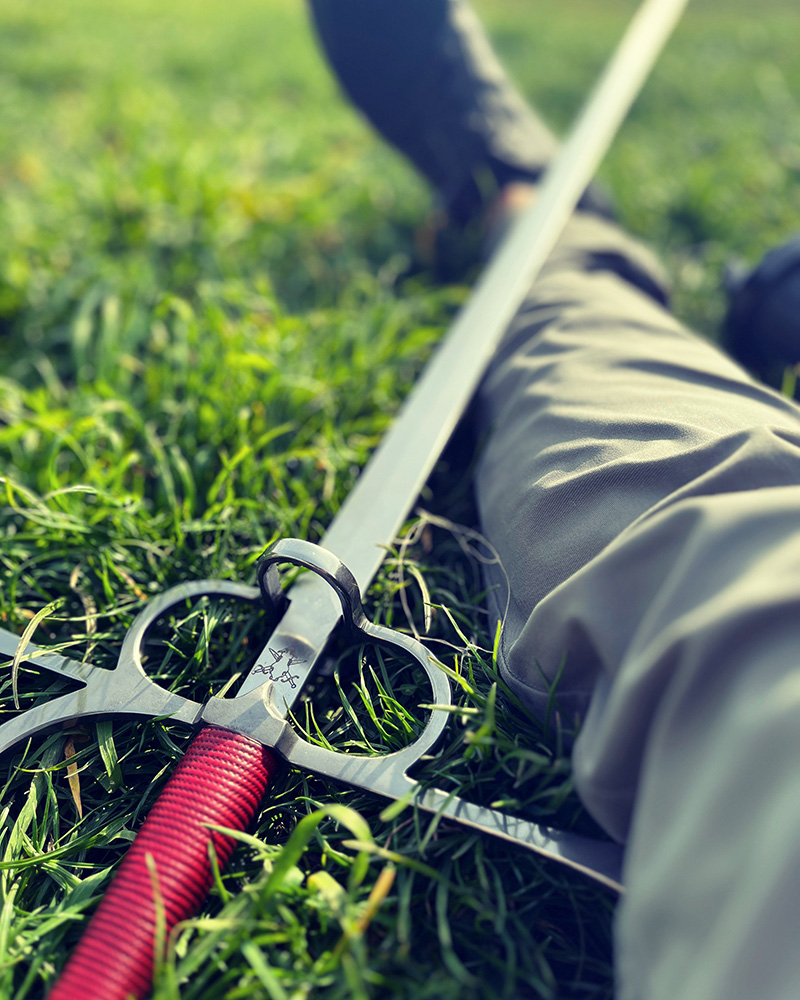
C. L.: With pleasure! I’ve been doing HEMA (Historical European Martial Arts) for four years now, and it’s been the lifelong dream of a young kid who always wanted to be a knight. I’ve recently gotten more deliberate about training to go to tournaments lately, which is a new challenge compared to learning just for the joy of it. (There’s also the joy of the challenge.) My main weapon is longsword, but I also really love messer (a long knife) and sidesword.
I’ve written about it in a bit more length here, with a follow up of how my first international tournament went, including some video of the bouts! Spoiler alert: I made it to eliminations! Where I was promptly…eliminated. But I was fighting the top seed, and I feel I acquitted myself admirably.
WOW: Thank you for sharing all this helpful (and cool) info with us! And good luck with your double book birthday on September 20!
C. L.: Thanks so much for having me!
***
Who’s ready to join an anatomy class with me? Or maybe you’d prefer to pick up a sword? However you approach your next story, I hope you’ll find C.L.’s advice inspiring!
***
Myna Chang hosts Electric Sheep SF and publishes MicroVerse Recommended Reading. Her fiction has been selected for the Locus Recommended Reading List, the BSFA longlist, Norton’s Flash Fiction America, and several “Best Of” flash anthologies; her poetry recently received an honorable mention in the Rhysling Awards. Her micro collection is available from CutBank Books. Find her at MynaChang.com or on Bluesky @MynaChang.