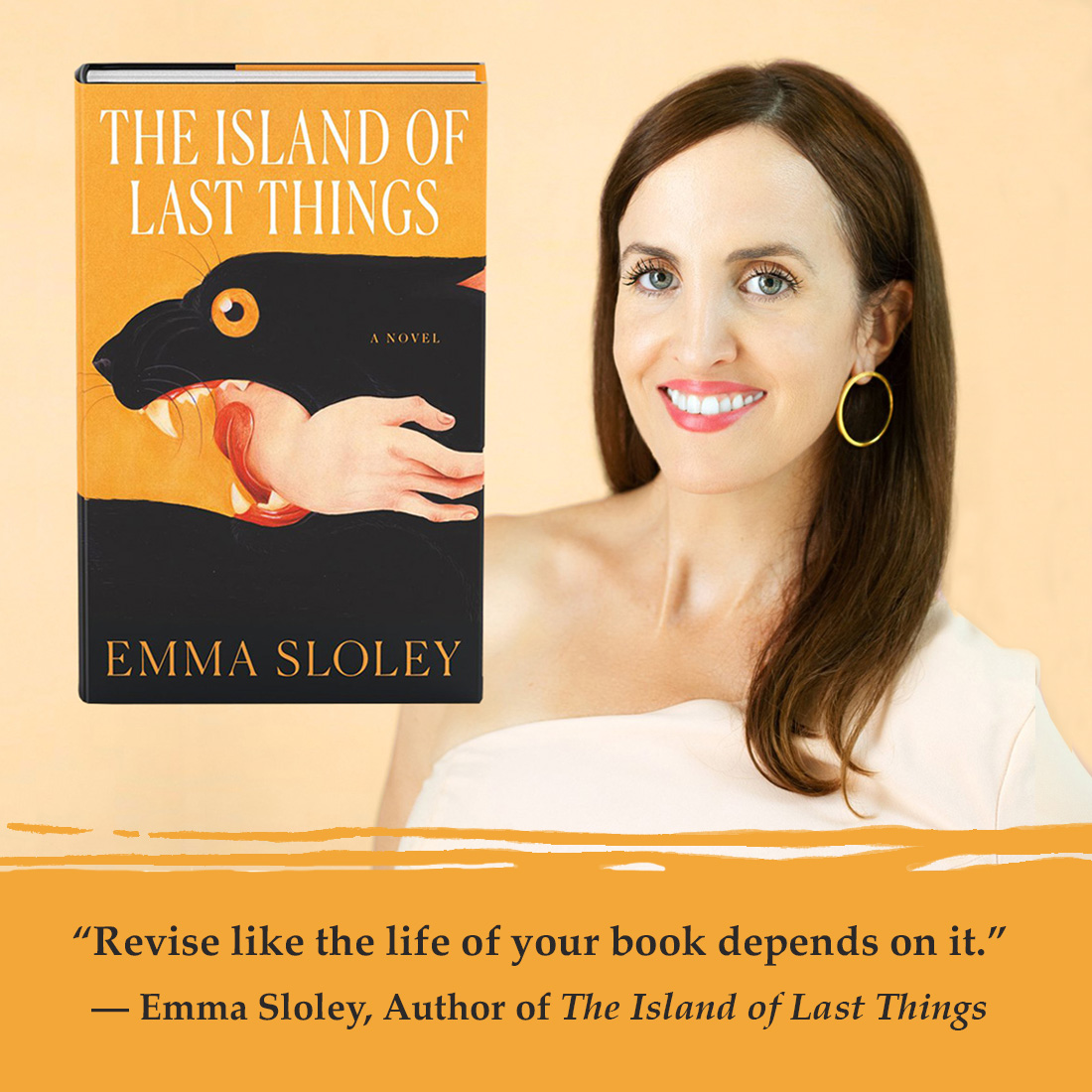
ave you ever thought about where the world is heading? Sometimes, books seem to predict the future or come scarily close. Emma Sloley’s upcoming novel, The Island of Last Things (Flatiron Books, August 12), is one of those books, like 1984 or The Handmaid's Tale.
But what sets The Island of Last Things apart from the above-mentioned books is that humans are not the focus. In a not-so-distant future, when air quality is poor, money and power still reign, everything centers around animals. Camille is a keeper at the last zoo in the world—on Alcatraz Island. A glimpse of the last of a species is highly sought, and those who live to conserve and preserve the last animals are caged just the same—until a new zookeeper, Sailor, arrives from Paris. She might just bring hope or chaos to Camille’s “safety.” With prose constructed with care and heart, The Island of Last Things is a unique and unforgettable read!
So without further ado, let me introduce the author, Emma Sloley, who began her career as an editor at Harper’s BAZAAR Australia before moving to New York to become a freelance travel writer. Her short fiction and creative nonfiction have appeared in literary journals, such as Catapult, Literary Hub, The Common, Joyland, and The Masters Review Anthology. Her debut novel, Disaster’s Children (A Little Books, 2019), includes dystopian themes about a woman who must choose between her own survival and that of humankind. Emma’s short stories have received recognition in several contests, including a finalist in The Missouri Review’s Jeffrey E. Smith Editor’s Award.
Her travel writing has been read around the world in well-known, prestigious publications, such as Travel + Leisure, Conde Nast Traveler, Departures, Coastal Living, Gourmet Traveller, Virtuoso Life and New York magazine.
As an Australian, it gives me great pleasure to chat with such an accomplished Australian-born writer. Emma now divides her time between the United States, Mexico, and various airport lounges.
Please enjoy this interview—it’s inspiring!
WOW: Hi Emma, thanks for taking the time for this Q&A. I’m honored to interview you. The Island of Last Things is such a unique story. How did you come up with the premise?
Emma: Thanks so much, Kelly. I really appreciate your interest!
A couple of years ago, I jotted an idea down in my notes app: World’s last zoo? I didn’t do anything more with it right away. Much later, I was scrolling through the ideas list, and it caught my eye and lit my brain up with questions. Where would one locate the world’s last zoo? The obvious answer—to me at least—was an island. Somewhere difficult to reach, hard to breach, removed from the diseases and dangers of the mainland. Given the story already had the structure of a near-future world, I could have invented an island. But I wanted to make the story feel more grounded in reality, so I started thinking about islands in our world. Tahiti sprung to mind. Australia (more specifically, Tasmania). Some unpopulated Caribbean or South Pacific isle. It was inevitable I’d eventually consider one of the world’s most notorious islands, famous for keeping people in (and out)—Alcatraz.
I’d never visited before, and I made a point of doing so the next time I was in San Francisco. The moment I stepped foot on Alcatraz, I knew I had my setting. It’s such an atmospheric place, both sinister in purpose and spectacular in setting. It had already functioned as a prison for humans. How difficult would it be to imagine other species trapped there as well? I could feel it happening as I explored the spooky cell blocks, this dark alternate reality coming to life.
WOW: Tasmania would have been a cool choice, but I think Alcatraz is absolute perfection. The atmosphere your setting creates has the feel of Manderley from Rebecca with eyes that see all. You published your debut novel, Disaster’s Children, in 2019. Second novels are often said to be harder to write. How did you tackle writing The Island of Last Things?
Emma: In a way, I consider it a blessing that my debut largely flew under the radar, so I wasn’t burdened with unrealistic expectations around my sophomore novel! I know of authors whose debuts were a huge success and who felt paralyzed writing a worthy follow-up. I was also fortunate that between when Disaster’s Children came out and selling The Island of Last Things, genre blurring became very big. By that I mean, books that blend literary fiction and genre fiction–sci-fi, speculative, thrillers, etc. (I’ve also seen this sub-genre called “upmarket.”) I’ve been lucky to write books that publishers feel bridge that literary/commercial divide.
While the core idea—Alcatraz as the setting for the world’s last zoo and two keepers who attempt to smuggle an animal off the island—has always been there, the story went through many iterations over the course of the three years or so I was writing it. It started out as a fairly straightforward first-person narrative told from Camille’s point of view. The “Sailor” sections came later, and it was only when I began writing her part that the story fully came together for me.

“Because I’ve lived across several cities and countries and time zones and traveled a ton for work, my relationship to the idea of home is very complicated. That definitely seeps into my writing—I think every protagonist I’ve ever written has been searching for home in some way.”
WOW: Sailor is such an important character. It just goes to show how stories are clay, and edits are paramount. You began your career in Australia as an editor at Harper’s BAZAAR and went on to work as a travel journalist. How have these experiences and locations impacted you as a writer?
Emma: My experience at BAZAAR was so formative in my journey as a writer. Even though I ended up in fiction rather than fashion magazines, my time there was absolutely invaluable in honing my writing and editing skills. It taught me to self-edit, a skill I think is vital for writers in today’s challenging publishing landscape. (More on that later.) And it made me a maniac for meeting deadlines, which is why I’m all my editors’ favorite writer, lol.
As for travel writing, because I’ve lived across several cities and countries and time zones and traveled a ton for work, my relationship to the idea of home is very complicated. That definitely seeps into my writing—I think every protagonist I’ve ever written has been searching for home in some way.
WOW: I love the concept that every protagonist is searching for home. The word home holds as much weight as the word happiness—it’s importantly complicated. You’ve had some pretty huge literary wins, including placing short stories in well-known literary journals, receiving the MacDowell Fellowship, and attending the exclusive Bread Loaf Environmental Writers Conference. Can you talk me through these major stepping stones in your writing career?
Emma: Oh, that’s sweet. I feel incredibly fortunate to have been published quite widely in a variety of literary journals I greatly admire, as well as being awarded those prestigious fellowships. MacDowell, especially, was a turning point in my writing career. It gave me permission to take myself and my work seriously and to be in cohort with some of the most talented artists working today. I’m so grateful for these vital institutions, and I wish there were more of these opportunities, especially for emerging writers.
WOW: It would be amazing if there were more opportunities for emerging writers! Let’s talk about getting those all-important yeses. How did you become an author?
Emma: My publishing journey has been a bit of a Goldilocks tale. I’ve had three literary agents, all New York-based: the first, who went on to sell my first book, decided to leave publishing shortly before my book launched. I signed with a second agent with whom I parted amicably two years later without ever going on submission, and now I’m with my third agent, a dynamo and superstar who signed me and very quickly found the perfect home for The Island of Last Things. So, much like a (non-Grimm Brothers) fairy tale, it all ended happily!
I don’t have an MFA, and I didn’t have any industry contacts when I began querying. There really aren’t shortcuts in this business, despite what our AI-pushing overlords want people to believe. The best and almost only way to get traditionally published is to write the very best book you can and send out cold queries to agents until you find someone who loves your book and wants to represent you. That’s it—incredibly difficult and incredibly simple at the same time.
“I don’t have an MFA, and I didn’t have any industry contacts when I began querying. There really aren’t shortcuts in this business ... The best and almost only way to get traditionally published is to write the very best book you can and send out cold queries to agents until you find someone who loves your book and wants to represent you.”
WOW: This is so inspiring for someone who has learned the craft of writing on their kitchen table while raising kids. And I’m going to quote Chuck Palahniuk here, “My education consists of a kitchen-table MFA.” There’s nothing like celebrating a publishing win, but I believe it’s even more important to talk about what came before. Can you share a rejection story?
Emma: I mean, how much time do you have?! There’s a saying in this industry that the only difference between a successful writer and a failed writer is perseverance. I’ve been rejected countless times by journals, contests, literary agents, publishers, residencies, and fellowships, and even though a couple of those nos were devastating at the time, I dusted myself off and kept going.
I think it’s also important for more established writers to talk about how even once you’re in the room, as it were—getting published by a big traditional house, winning awards, racking up accolades—there is still a ton of rejection. Even when your career is thriving, there are fallow times when no one seems to be interested in what you have to say. Get used to writing into the silence, I say! That’s where the magic happens.
WOW: Yes! I wish more published authors talked about the ongoing rejections they face so that we may all find happiness in the magical right now. What does your typical day of writing look like now?
Emma: I work from home (which is in Southern California, currently). I’m fairly disciplined. I get up around 7 a.m., do yoga, have breakfast, talk nonsense with my delightful writer husband Adam, and then start work. I write at our dining table. We still travel a lot, and I’ve had to become adept at working anywhere and in any kind of jetlagged state, so nothing really phases me. At home, we both work a fairly standard workday, around 9 a.m. - 6 p.m. most days, with breaks for lunch and doomscrolling. All that time isn’t spent writing, of course. Depending what stage I’m at in a project, I might be working on an outline, doing copyedits, researching, or as is the case at the moment, dealing with publicity and marketing efforts for my upcoming release.
WOW: Working from home is the best! I’ve noted an abundant amount of great writing in The Island of Last Things. Did you make a conscious effort to, for example, pick impactful verbs, and if so, at what point of the process did you craft those noteworthy sentences?
Emma: Thank you, that’s lovely to hear. Language is so important to me, as both a writer and a reader. Beyond a compelling story, it’s probably the single most important factor in whether I end up loving a book. I don’t mean just beautiful sentence-level writing, but writing that deploys description and metaphor and interiority in ways that resonate deeply with the reader. Not to get all Hemingway about it, but the insights should feel true—like I should understand more about the world after having read a great scene—not just the world of the story, but the world as we live in it and experience it. If I have a North Star in my process, that would be it.
“Revise like the life of your book depends on it. (Because it does.) Get feedback from trusted beta readers, find a writer’s group where you can critique one another’s work, and seek out a literary community. When you think you’ve gone as far as you can with your book, do another pass.”
WOW: What you have achieved with this novel affects the reader deeply. What’s your top tip for aspiring authors?
Emma: Make sure your manuscript is in the most polished state possible before sending it out. Agents and editors are really overworked, and these days, they tend to be looking for manuscripts that are already in great shape. Revise like the life of your book depends on it. (Because it does.) Get feedback from trusted beta readers, find a writer’s group where you can critique one another’s work, and seek out a literary community. When you think you’ve gone as far as you can with your book, do another pass.
Also, I know a lot of new writers stress about having a platform and lots of followers, etc., but I’d definitely advise doing only what you’re comfortable with in the social media arena. It can be fun and occasionally even useful (I’ve made some great writing contacts on social media, and I think the Bookstagram/BookTok community has been a huge boon for authors in getting people excited about reading again), but as we all know, these platforms can also be extremely toxic and anxiety-inducing. The thing you have the most control over—maybe the only real control over—is the quality of your book.
WOW: Great advice! Okay, last question! Post-COVID, I’m seeing a lot more climate fiction being published. I feel like this novel is timely and dark, forcing us to consider some serious points such as, “There’s a lot of country between what you want to be true and how the world is.” What’s the most important message you hope readers will get from this novel?
Emma: I hope it sparks debate about our complicated relationship with animals and the natural world. Look, I don’t think this is a political book, but the fact remains we are alive in a time of dystopia, when our planet and the living beings that depend upon it are under attack in so many ways. We need to protect our wild spaces, our right to breathable air and drinkable water, and our right to live joyful and free lives. And if Camille and Sailor’s story helps people think about what role they want to play in fighting for those things, that would be humbling and wonderful.
WOW: Amazing! Thank you so much for taking the time to answer my questions.
Emma: Thanks so much for inviting me!
My thanks to Emma Sloley. It’s been an absolute pleasure to chat and talk about writing. I’m inspired to edit my manuscript into a thing of beauty and then get back in the query trenches, seeking a new agent!
To find out more about The Island of Last Things, visit the publisher’s website, or purchase a copy from Amazon or Bookshop.org. And follow Emma via socials.
***

Kelly Sgroi is based in Melbourne, Australia. While preparing her next manuscript for submission, Kelly regularly interviews authors, runs @WriteTillChristmas, and contributes to WOW! Women on Writing. To find out more about Kelly visit www.kellysgroi.com.