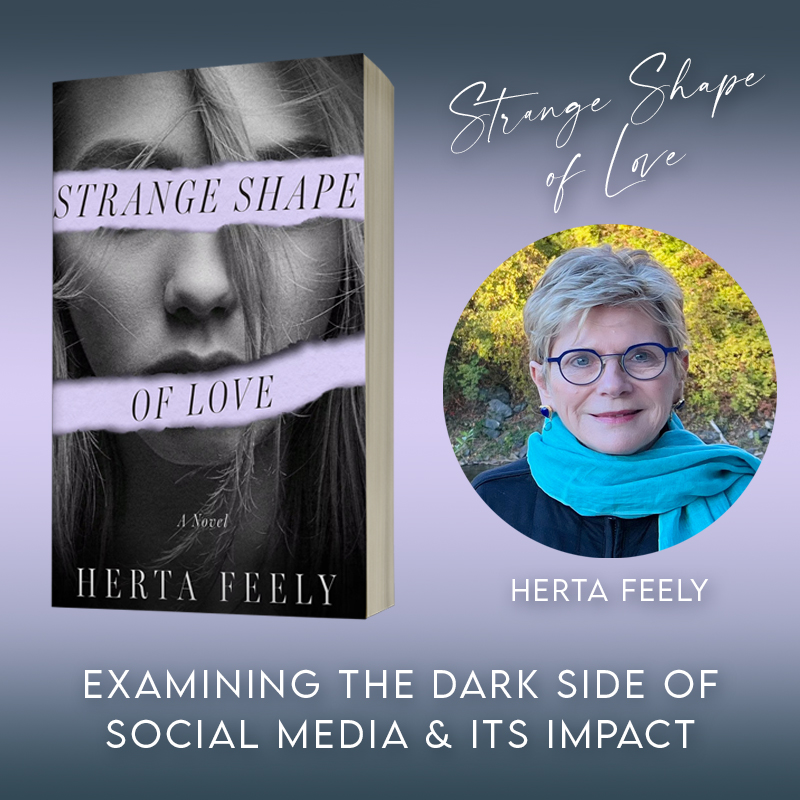
As a true crime writer and podcaster, I know what it’s like to find inspiration for my work from the national headlines. As author Herta Feely came across news stories about cyberbullying, sextortion, and the #MeToo movement, her latest novel began to take shape.
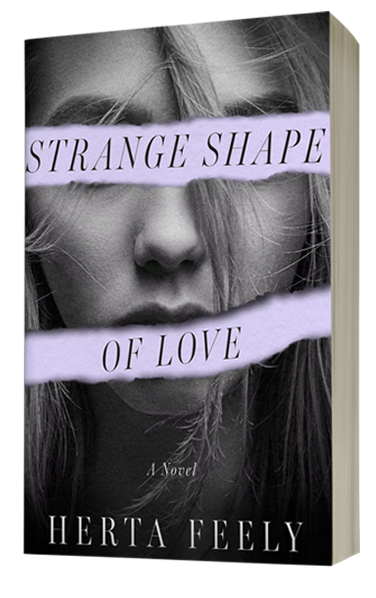 Charlotte Cooper thought she’d finally rebuilt her life. A new reporting job. A home in London. A second chance with the man she loved and lost. Then an anonymous envelope arrives—five explicit photos from her past and a threat that could destroy everything.
She has two weeks to uncover who’s blackmailing her… or watch her career, her reputation, and her future go up in flames.
Her first novel was inspired by the same topics, with a younger victim at the heart of the story. With a curiosity about injustices here and abroad, Herta began her professional career working for Amnesty International before attending journalism school at UC Berkeley. Her writing explores racism, immigration, interpersonal relationships, climate change, and more. When she’s not working on her own projects, she offers guidance to other writers through her editorial services.
Herta Feely is an award-winning author and editor at Chrysalis Editorial, where she has worked with hundreds of writers to achieve their publishing goals. She is the author of Strange Shape of Love, published in 2025, and Saving Phoebe Murrow, her critically acclaimed debut novel. Both works of fiction explore the dangers of social media—“sextortion” or revenge porn in the former, and cyberbullying in the latter. Her work has been published in numerous anthologies and literary journals. Based in Washington, D.C., Herta is also a ghostwriter and has written several people’s memoirs. She is the co-founder of Safe Kids Worldwide, an organization dedicated to preventing unintentional injuries to children, which she launched in 1988. She can be found online at www.chrysaliseditorial.com and www.hertafeely.com.
***
WOW: Hello, Herta, and thank you for taking the time out for this interview. I’m excited to learn more about your novels and what inspires your stories. You have an impressive portfolio of work, and if possible, I’ d like for us to start when you first knew you were a writer. Was there a specific moment where you realized your own place in the world of storytelling?
Herta: It may seem silly, but in sixth grade I wrote a story titled “Bombs Away,” and received an A. I was very proud of that story—set around the time of the Cuban missile crisis—and wished I might become a writer. (I tend to have some political or social issue at the heart of my stories, and this is where it all started!)
My plan was to study English literature in college and then teach high school English. For someone who knew she’d need a steady income that seemed like a more practical profession than writing novels. However, I always dreamed of becoming a novelist.
As is often the case, life had other plans for me. I ended up studying Latin American History at UC Berkeley. With that degree I became a press secretary for Amnesty International in San Francisco, which gave me the courage to apply to Berkeley’s journalism graduate school. After grad school, writing became a part of my professional life, and I began working on a semi-autobiographical novel, one I didn’t finish until my 40s. But that led to fulfilling my dream of becoming a fiction writer by applying to the Johns Hopkins graduate writing program. Eventually, some of my short stories and memoir were published, and I found my way to writing a contemporary novel about cyber-bullying (Saving Phoebe Murrow), published in the US and the UK in 2016.
WOW: What a fascinating career trajectory! I’m in awe of all you accomplished before even publishing your first novel. Your debut, Saving Phoebe Murrow was a National Indie Excellence Award Winner. Could you tell us a little more about the topic of that book?
Herta: In 2008, I read an article in the Washington Post about a young girl (Megan Meier) who committed suicide after being cyberbullied. A powerful image of Megan’s distraught father seated at the end of her bed accompanied the piece. At the time I knew little about social media and was shocked to learn how a group of Megan’s classmates had sent cruel messages to her (via MySpace). Even more shocking was the fact that a 47-year-old woman who knew the Meiers had used a fake profile of a 15-year-old boy to lure Megan into communicating on social media and then turning on her. This prompted me to investigate social media, and I discovered its dark side (cyberbullying, phishing, trolling, etc). While my novel was inspired by Megan Meier’s story, it is not based on her story. In less than a year, I’d created a fictional cast of characters and a unique plot, which became Saving Phoebe Murrow set in Washington, D.C.
WOW: It’s not hard to find real-life stories of people who have been driven to suicide after experiencing cyberbullying, catfishing, and sextortion and it’s heartbreaking. I’ve covered many on my podcast. Saving Phoebe Murrow also addresses different parenting styles (especially among women) and the “mean girl” behavior among the female population. Did you ever experience an instance of this in your own life and how did you deal with it?
Herta: As a seven-year-old girl, not long after we’d moved to the US, I arrived at school one day to find the children avoiding me. I couldn’t understand what had happened, because previously they’d been welcoming, but then a boy ran by and yelled, “Nazi!” I didn’t know what that meant, but once I found out, I felt ashamed and wanted nothing to do with being German. That experience and a few similar ones haunted me for a long time. But they also gave me a deep understanding of children who are excluded, made fun of, or victimized in other ways. It helped me to understand Phoebe, my main character in Saving Phoebe Murrow.
WOW: Children (and adults!) can be so cruel, and I don’t think they understand how these types of remarks can affect a person. I understand that Strange Shape of Love was longlisted in Uncharted Mag’s novel excerpt contest. How did the idea for the plot about the digital culture’s influence on our most intimate relationships come to you?
Herta: Strange Shape of Love continued my fascination with social media and its impact on our culture, its dark side.
The idea of my protagonist Charlotte receiving nude photos of herself came from several female celebrities’ phones being hacked and their nude photos posted online. This included Jennifer Lawrence, who was outspoken about the issue and said she could attend any party and know that most likely people had seen her nude. I recall thinking what a terrible invasion of privacy that was and what it must be like to be so exposed. In Charlotte’s case it threatens everything important in her life – her job, her home, her love. These days it’s also used as blackmail, or “sextortion.”
For Strange Shape of Love, I was also influenced by the #MeToo movement, which illustrated that women have been shamed and silenced far too long. I read Ronan Farrow’s Catch and Kill, which exposes high-level executives like Roger Ailes, Harvey Weinstein, Matt Lauer and others. Charlotte experiences a similar pressure when she’s offered an on-air reporting job, and through her reporting she tells stories of women harassed online. I wanted to give these women a voice, even if in fictional form.

“Allow characters’ actions to unfold the plot, I suggest, don’t be a puppeteer. But it takes time to get to know your characters and how they might behave, which usually means you need to do character-writing exercises before even beginning to write the story.”
WOW: In an interview with Linda K. Sienkiewicz, you mention that the first version of Strange Shape of Love was a lot different from the finished product. Why did the protagonist and setting change and what can readers take away from your experience?
Herta:
Having worked in the human rights field (Amnesty) and daily reading reports of human rights abuses in the Middle East, Syria and Saudi Arabia in particular, I imagined a 40-year-old Charlotte Cooper working in human rights and exposing some of these atrocities (setting: Turkey and Syria). My publisher wasn’t keen on that concept and asked me to rethink it.
What remained the same in each version were the five nude photos threatening to upend Charlotte’s life and also a romance, but the mystery and thriller aspects of the photos and the love interest changed entirely, including Charlotte becoming a 30-year-old reporter sent to London. In effect, I wrote three very different drafts before landing on the one I felt comfortable with and proud of. Charlotte as reporter allowed me to delve into the dark side of the internet, including human trafficking.
WOW: In your discussion guide for the Strange Shape of Love, you ask the readers what they can do to protect themselves and their children from social media attacks. What are some of your suggestions in this Wild West of a digital landscape?
Herta: I think it’s very difficult to protect ourselves and our children in this digital age, but we owe it to ourselves to make the effort. For example, it has been recommended that in your social media you refrain from posting your children’s photos and providing their names, schools, and home addresses. It’s a shame not to be able to share such photos online with your friends for fear that a predator may be taking note and might someday prey on you and your children, but there’s definitely a risk involved these days. By going online, you can find organizations that help parents navigate this Wild West terrain, including Family Online Safety Institute, Connect Safely, iKeepSafe, which teaches children online safety, and Parents for Safe Online Spaces.
WOW: Knowing that you are currently in Florida while we’re conducting this interview, what does a day in the life of Herta Feely look like?
Herta: Smile. While in Naples, I prefer to start my day with a fifteen-minute swim. Because I’m working on a memoir (working title: Angels in Disguise), I try to write for at least a little while before emails and other distractions, including social media. I also usually have something I’m working on for a client. Later in the afternoon, when time permits, I ride my bicycle, take a walk through the Naples Botanical Garden, or even my neighborhood, where it’s not unusual to run into herons, ibis, egrets, osprey, alligators, iguanas, and other wildlife. In D.C., life isn’t quite so laid back.
WOW: Sounds like a wonderful schedule with plenty to keep your mind and body moving. You’re also the founder of Chrysalis Editorial, where you help authors achieve their writing goals. What types of services do you include under this umbrella?
Herta: I provide an array of services including developmental edits of fiction and memoir manuscripts, assisting writers in developing book proposals (non-fiction), writing query letters, and providing publishing advice. The work I do is rarely boring, and I often learn new information in the process, as with a current project in which I’m editing 22 writers’ stories for a book about stroke awareness. I can’t complain—it’s a wonderful job!
WOW: What is the most common issue you see among writers seeking your help?
Herta: Many writers are looking for support in their writing journey, because, as you know, it can be a lonely one. Sometimes becoming their writing coach can provide them with the courage, inspiration, and structure to continue writing and finish their project, be it fiction, memoir, or non-fiction. I’ve worked with many writers in all three categories and feel very happy and satisfied to have helped them get published.
In fiction, character development and plot rank right up there as frequent challenges. Allow characters’ actions to unfold the plot, I suggest, don’t be a puppeteer. But it takes time to get to know your characters and how they might behave, which usually means you need to do character-writing exercises before even beginning to write the story. Memoir is a slightly different animal, but many of the fiction elements apply—character, plot, point-of-view, setting, dialogue, tension, etc. For many people, it’s not clear what the difference is between memoir and autobiography, so I always start there. With non-fiction you only need a few chapters and a book proposal, but it’s painstaking work, nonetheless.
Patience is required no matter the genre you’re working in and so is sitting down at your computer regularly and putting in the work. A story doesn’t write itself.
WOW: I appreciate this advice on using character-writing exercises. All too often we’re eager to jump into the plot before we truly have a sense of who our protagonist is and what motivates him or her. And memoir is a lot harder than it looks!
As an accomplished writer who has also published essays and short stories, what topics do you like to explore in your shorter pieces?
Herta: I tend to incorporate themes that resonate for me: immigration, racism, climate change, and problems we encounter in our relationships (betrayal, conflict, loss, etc.) Because I now have two young grandchildren, I worry about them and think about how different their lives will be from my sons’ childhoods and my own. This too makes for interesting thinking and the potential for stories, i.e., social media, screentime, bullying, online predators, etc.
“Patience is required no matter the genre you’re working in and so is sitting down at your computer regularly and putting in the work. A story doesn’t write itself.”
WOW: Thank you for sharing those with us—all are timely, relevant, and relatable! What types of books do you normally reach for when reading for pleasure?
Herta: I read all manner of books—fiction, memoir and a little non-fiction. Within the fiction category I enjoy literary and stories with mystery and tension, which often means it contains a thriller element as in my own novels. Right now, I’m reading Lily King’s Heart the Lover, About the Author by John Colapinto, The Measure by Nikki Erlick, Raising Hare by Chloe Dalton (memoir), and The Secret Life of the Universe by Halie Cabro (non-fiction).
An all-time favorite novel is Station Eleven, in which a pandemic ravages the world while a theater company is performing Shakespeare. This idea grabbed me, and I borrowed it in Chapter 2 of Strange Shape of Love. Charlotte and her seatmate are on a flight between New York and London. The scene explores the idea that a pandemic could circle the globe while they’re aloft. I used it to indicate that danger lies ahead for Charlotte and Regina, although their tragedy is far removed from the pandemic.
WOW: I remember that scene! Herta, thank you again for such a lovely and encouraging conversation. I encourage everyone to check out your work through your websites.
***
To find out more about Strange Shape of Love and Saving Phoebe Murrow, visit Barnes & Noble, Amazon, or Bookshop.org. You can find Herta on Instagram and Facebook.

Renee Roberson is a freelance writer, editor, and host/creator of the true crime podcast, Missing in the Carolinas. She is currently seeking representation for her suspense novel about a podcaster searching for her missing sister. Learn more at FinishedPages.com.