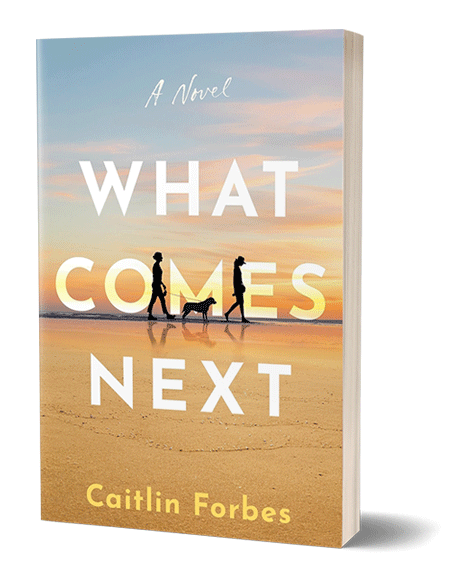
Throughout our lives, we face two different coming-of-age phases. The first comes in our teen years as we enter into the awkward and unfamiliar puberty stage; the next comes when we leave our teenage selves behind and we begin our lives as adults. Both phases come with unique, complicated emotions that can build our character, strengthen our identity, and reveal aspects of ourselves that can shape our future.
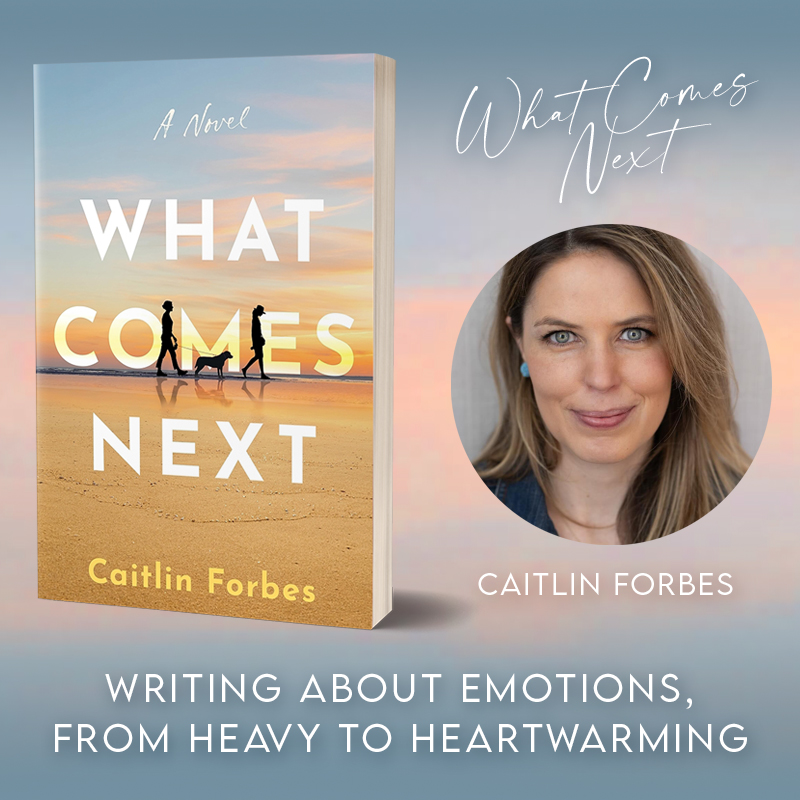
In What Comes Next, Caitlin Forbes explores the second coming-of-age phase with a complex twist: facing the potential diagnosis of a fatal genetic condition. That’s what Alex and her sister Meredith realize what’s before them as they learn of their estranged mother’s passing. Her empowering and heartfelt novel addresses the complexities of family, the power of sisterhood, and the bravery it takes to choose happiness when all seems lost.
Caitlin Forbes and I discuss these complexities of emotions revealed through her writing. She is a Maine-based author who writes stories that explore the messiness of relationships—from sisterhood to romance to the tricky relationship we have with ourselves. When not writing, you can find her chasing after her toddler (or her dog) and exploring small-town New England life.
WOW: First of all, congratulations on your book, What Comes Next. You’ve written such a powerful book that explores the emotions of not only emerging into adulthood, but also facing a potentially fatal disease. What inspired this book?
Caitlin: Thank you for reading the book! Being a debut novelist is more than a little terrifying, and I am deeply grateful for the kind words and support from readers.
I’ve always been drawn to conversations about genetics… about what is and is not in our control, and the very specific question: how do you move forward despite inevitable loss? A question that, of course, extends beyond disease and into life in general. Because there will always be loss. But there’s also all the moments in between… Even right now, when the world feels incredibly dark sometimes, there are these snippets of love and laughter and beauty—if you can find a way to see them.
And that’s how Alex came to life. This young woman, in her late twenties, who was unquestionably stuck, who did not know how to jump, who faced deep self-doubts… and who seemed so far from resilience. I wanted to watch her grow, because I wanted anyone who read the book and had ever had a hint of that voice in their head—the one saying, you’re not enough, you can’t do this—to meet Alex and feel seen in some small way. To know that their feelings and struggles are simply human, not a sign that they are less. And to believe that something better really is coming next.
That’s what my favorite novels have always done for me.
WOW: I love that you wanted your readers to feel seen. Did you do much planning in advance before writing? Or are you more of an explorer (discover your plotline as you go)?
Caitlin: I am somewhere in between! I like to know the overall arc of my characters and plotline—a high level outline—but I don’t bother digging into the specific details because I know those will change. I learn about my characters as I write them. They move from an idea into real people with deeper motivations than I might have realized at the start… and at that point, their choices feel a bit out of my control. So, I start with that high-level outline, and then I do intensive outlining (scene by scene) for the next four chapters or so, leaving room to learn as I go. And keep repeating that until I have a draft.
WOW: That’s a good approach! Why did you decide to write in first person?
Caitlin: Many of my favorite authors write in first person, so I was largely inspired by their work. As a reader, I love the intimacy of the first-person structure. I think the beauty of fiction is in the moment when the reader stops feeling alone—when they feel understood because they’ve connected with the character on a fundamental level. And for me, first person delivers that in a really unique way.
“I think the beauty of fiction is in the moment when the reader stops feeling alone—when they feel understood because they’ve connected with the character on a fundamental level. And for me, first person delivers that in a really unique way.”
WOW: Yes! Beautifully said about the reading no longer feeling alone. There are so many heartwarming, emotional scenes in this book. How did you manage to capture them so well?
Caitlin:
Heavy topics engender intense emotions, which of course supply endless fodder for writing. To me, the harder part (and maybe the more worthwhile part) is digging into that heaviness and finding the joy and beauty underneath it. This was really the challenge and eventually focus of WCN, and Alex as a character—to watch her learn that: yes, okay, there are so many horrible things, but yes, also, look at all the good. To do justice to both parts of this experience—the heaviness and the hope.
A few specific tactics I used to get there:
- I often read poetry before I write emotional scenes. I am in awe of poets—their ability to say so much in just a few words, to capture the heartwarming and the heavy—and reading a poem is quick way to get me in the right mindset to try to capture big emotions.
- I don’t shy away from my character’s headspace. When I’m writing, I think about them all the time. When I’m in the shower, when I’m reading other books, when I’m walking my dog or talking to a friend… these big scenes and their reactions are always in the back of my mind. And often, I’ll get inspiration/insight on a scene during these “non-writing” moments—during the beautiful, messy life moments—and I’ll put the idea or phrase in my phone’s notes app and that becomes the start of whatever I write later.
WOW: Great tactics. What was your revision process like after you finished your first draft?
Caitlin: Oh boy—it was intense! I actually joke that this is my second novel, not my first, because that’s how much the draft changed. The first version of WCN spilled out of me without any consideration of key craft elements like building tension or pacing or character development beyond Alex (yes, I walked directly into that particular trap of first-person novels). One of my friends read both versions and she was so surprised; she called me, asking: did you keep anything??
The first draft for me was about realizing I could do this: I could write a story from start to finish, 80,000 words. I could pour my feelings and my thoughts into characters, who then took them and changed them, and at the end: there was a book.
I put it away for three months, then took it out and re-read it and decided it was lacking… but that I still believed in the story. I enrolled in a writing class to try to understand a bit more about the craft of writing, and I started over. I rewrote probably all but 5,000 words. But Alex was always Alex. Meredith was always Meredith. I just learned how to actually make them alive in a place outside my head.
“I often read poetry before I write emotional scenes. I am in awe of poets—their ability to say so much in just a few words, to capture the heartwarming and the heavy—and reading a poem is quick way to get me in the right mindset to try to capture big emotions.”
WOW: What a process! Your book proposes a complicated question: if you had a genetic condition that would eventually be fatal, would you want to know? How did you explore answering that question for your characters?
Caitlin: One of the most interesting findings in my research was that most people who might have Huntington’s Disease (HD) choose not to get tested. And yet, when HD comes up in pop culture, it almost always ends with the person finding out. So I really wanted to honor the other story… the one that was maybe a bit more real. I wanted to create a character whose first inclination was “no” and then help the reader really understand that motivation. So I dove into my research, poring through first-person narratives and stories and chat rooms and talking to providers. And what I found most compelling was that the choice to not know isn’t as simple as avoidance. It can actually be the choice that lets someone move forward.
It was also really important to me to portray the nuance underlying this decision. Alex’s choice is Alex’s alone. Meredith’s is Meredith’s. There are a thousand ways to approach this question, and there’s no one answer that reflects the community of people who are dealing with this question. Especially given that the science is always changing.
As an important aside: there was a recent breakthrough in HD treatment, which is incredibly exciting, and again points to the nuance of this conversation.
WOW: That’s definitely a complicated question, and you addressed it well. You actually do have a medical background as a health care strategist! How did that inform your writing of this novel?
Caitlin: It certainly informed my research and my ability to tap into early readers who brought a health lens. But I hope, most importantly, that it gave me the tools to write a story that is not my own. I spent the first half of my career writing in the health care space. This meant interviewing other people—community health workers, parents and patients, medical providers—and writing their stories. And I don’t take that job lightly. It’s a huge responsibility to sit with someone else’s experience and try to do it justice, and that’s how I approached WCN. I spoke with experts, I read article after article, I found first-person narratives, I read critiques on fiction that deal with disease and I tried to honor those concerns, and as I said at the start: I made sure I tapped the right early readers.
WOW: What an incredible amount of work you did! I loved the included element of the dogs in the book. It was one of my favorite parts! Did that naturally come out as part of your main character’s life and personality (to love dogs)?
Caitlin: Oh my goodness, I am so glad you liked the dogs.
Yes—the dogs were in there right from the very first draft, though the plot line certainly evolved. What Comes Next is not autobiographical, but the dog pieces were absolutely inspired by my experience with my own dog—a 100-lb shepherd who needed some pretty intensive training. I was learning all about reactivity and fear in dogs while writing WCN, and the parallels were incredible.
It also made so much sense to me that Alex can see these things with dogs, but not with herself. Dogs (and animals) bring out a softness and generosity that we don’t always offer to ourselves, so I loved having the reader see this softness in Alex long before she was ready to give herself that same grace.
“I learned right away that I had write for myself and no one else. But even if you can stay focused on your work, it’s still terrifying: putting a little piece of your soul out there for critique and rejection—first from agents, then publishers, and ultimately readers... It is genuinely the hardest thing I’ve ever done.”
WOW: What a great balance. It’s incredible that this is your debut novel! What have you learned about yourself and the writing world while publishing this novel?
Caitlin: Publishing a novel is arduous. You write your novel; you edit your novel; you edit it some more; and then you start querying agents. And if you’re lucky enough to get an agent, there’s more editing and then, onto querying publishers. All before you get a book deal. That’s an incredible amount of work without any assurance of publication… I learned right away that I had write for myself and no one else. But even if you can stay focused on your work, it’s still terrifying: putting a little piece of your soul out there for critique and rejection—first from agents, then publishers, and ultimately readers… It is genuinely the hardest thing I’ve ever done.
But it also changed my life. Writing this book taught me how much I need writing. How it centers me and helps me learn about myself and the world around me. It made me a better person—more patient, more self-aware, more empathetic, and more self-assured.
The publishing part? Not my cup of tea. The writing? Worth everything that comes around it.
WOW: I know what you mean! What advice do you have for authors trying to publish their own debut novel?
Caitlin: Don’t give up, and don’t have an ego. And remember why you want to tell the story you’ve chosen. When I was in the midst of self-doubt moments (e.g., I am a terrible writer or I will never get a book deal), I would tell myself: all I want is to write a book that helps even one person feel like they can move forward, like they are enough just as they are. One person—that’s my focus.
And then, I’d keep at it.
“Writing this book taught me how much I need writing. How it centers me and helps me learn about myself and the world around me. It made me a better person—more patient, more self-aware, more empathetic, and more self-assured.”
WOW: Great advice. What are you working on now that you can tell us about?
Caitlin: Well, I’m big on writing about emotions, particularly how the heavy ones often sit next to the heartwarming ones, and my current work in progress is actually focused on anger of all things. But really: I’m fascinated by the different ways women manage their rage while navigating the world around them. So, I wanted to write a story about a woman coming to terms with an emotion that is less popular and certainly less acceptable. And this led to Hannah Sullivan, a semi-famous athlete and a wife and a best friend and a daughter… who hits a wall in trying to be all things for everyone. And when she gets angry… well, the world certainly starts to pay attention.
WOW: Thank you so much for your time. And I hope to see more of your work in the future!
***
Nicole Pyles is a writer living in Portland, Oregon. Her writing has appeared in Sky Island Journal, Arlington Literary Journal, The Voices Project, The Ocotillo Review, and Gold Man Review. A poem of hers was also featured in the anthology DEAR LEADERS TALES. Her short story, “The Mannequin of Lot 18,” was nominated for Best American Science Fiction and Fantasy for 2024. Since she’s not active on social media very much, stay in touch by following her writing blog at World of My Imagination or her Substack, Nicole Writes About Stuff.