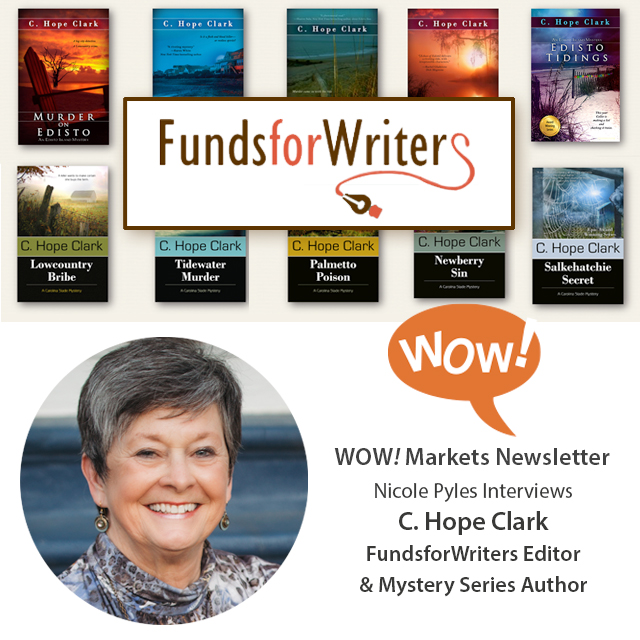
In a time when social media is more splintered than ever, and creating your own platform as a writer seems almost impossible, it’s no small feat to have an established audience of readers. C. Hope Clark started her newsletter in the early days of the internet, when having an e-mail newsletter was new, novel, and hadn’t really been done before. At least, not by many. Now, more than twenty-five years later, FundsforWriters remains a staple in the writing world. A must-read when there are very few reliable “must-reads” out there online anymore.
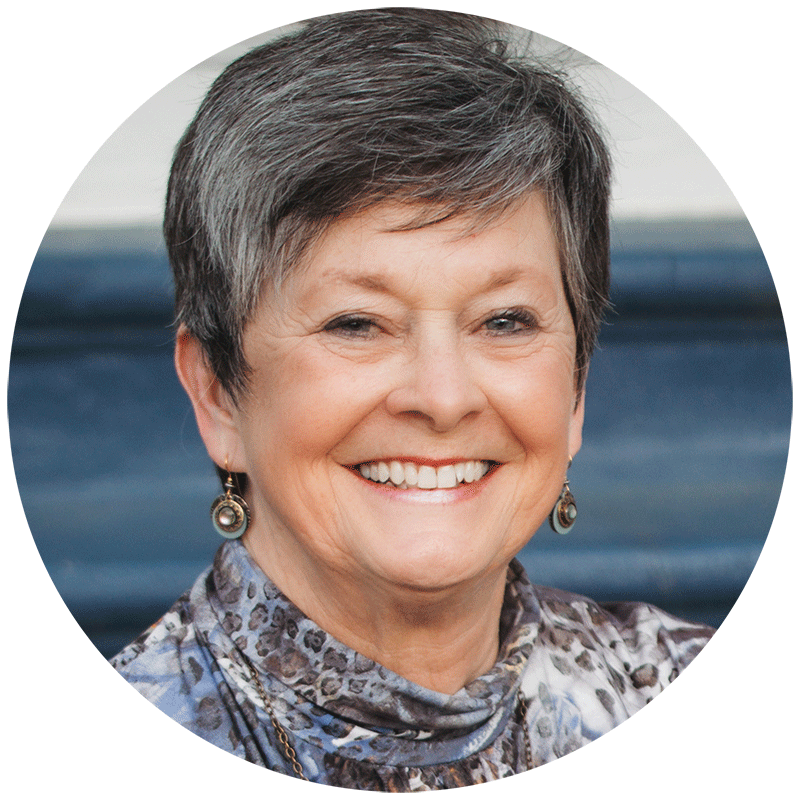
 Hope holds a B.S. in Agriculture with honors from Clemson University and twenty-five years’ experience with the U.S. Department of Agriculture. It enabled her to talk the talk of Carolina Slade, the protagonist in her first novel series. Her love of writing, however, carried her up the ranks until she could retire early. She left USDA to pen her stories and freelance.
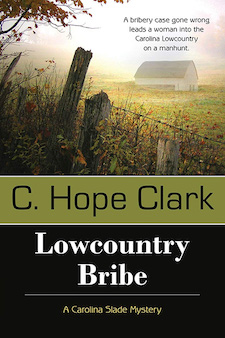
Hope is married to a thirty-year veteran of federal law enforcement, a Senior Special Agent. They met during a bribery investigation within the U.S. Department of Agriculture, the basis for the opening scene of Lowcountry Bribe.
Hope currently manages FundsforWriters.com, a weekly newsletter service she founded that reaches 28,000+ writers, including university professors, professional journalists, and published mystery authors. Writer’s Digest has recognized the site in its annual 101 Best Websites for Writers for two decades.
WOW: I’ve been a follower of your newsletter for years. When did you first start your newsletter and why?
Hope: I started the newsletter in 1999 when I could find nothing like it online. I had already been freelancing and had a partially completed novel manuscript and sought publishers and contests. I was working with the federal government and understood grants, so I was looking for those as well. After collecting tons of resources, I realized others might need this as well since it was so difficult to find. I created FundsforWriters for that purpose. To assist writers who would rather be writing than hunting for these resources. 200 signed up in two months. 2,000 within six months, and that was back when there were only three newsletters for writers in existence. Today, we have 28,000 and have maintained that number for years. Our open rate is 30-35% which is pretty huge.
WOW: That is phenomenal! That you have continued your newsletter all these years is equally impressive. As a blogger and half-hearted newsletter writer myself, I know how much effort it takes to keep up the momentum with a newsletter. How have you maintained the effort for your newsletter all these years?
Hope: I enjoy writing essays. I enjoy research. After a while, resources started contacting me to be in the newsletter, versus me having to ferret them out. They wanted me as much as I wanted them. But I format newsletters going out six months, and depending on the deadline dates on these resources, I populate these newsletters. So I have a ritual now, and ample contacts to keep it alive and well.
WOW: It must help to have so many people reach out to you with their own resources. How did you start growing your audience?
Hope: I reached out to people at first because there were no blogs. There was no social media. It was purely word-of-mouth and email. I made appearances at writers’ groups and conferences and had sign-up sheets. But then Writer’s Digest heard about what I was doing and chose me for its 101 Best Websites for Writers, and it took off. FFW has been on that list every year since then.
WOW: Congrats on being included as one of the best websites for writers. I’m fairly confident that’s how I found you, too! With social media so splintered now, I feel like “owning” your audience with a newsletter is the key to having an effective network as a writer. What advice would you give to a writer interested in starting their own newsletter?
Hope: Set a schedule and adhere to it religiously. It doesn’t have to be long, but it better be consistent, or you lose people quickly. You also need to have personality, or a unique voice. Don’t sound like everyone else. So many newsletters out there just run together, and you can tell the writer really doesn’t want to be doing it. Readers can tell.
WOW: I think consistency is a major factor. And of course, with all of this said, you are a prolific, talented, and successful author. I can’t help but feel so impressed by the number of books you’ve published and how well they’ve done. Have you always wanted to be a mystery author?
Hope: Mystery has always been my favorite genre. But I did internal investigations with the federal government, and my husband is a federal agent (now retired). We love this stuff and talk about it all the time. But I love writing. It is really that simple. I do not know what I would do without it. From the time I was in middle school, I recognized that good writing opens doors and garners respect, so I vowed to own my writing in all that I did. It has paid off in so many ways.
“Writing comes first after family, and my family knows it. The house can get dirty, the weeds grow, and the laundry piles up, but I will get my word count in ... It’s all habit now. But I feel like I haven’t brushed my teeth if I haven’t written that day.”
WOW: You are right about that. Good writing definitely opens doors. I can’t believe you met your husband during a bribery investigation! Can you tell us a bit about that? And with his federal agent background, does he help you with research?
Hope: Yes, I was still with the federal government, and a client offered me a $10,000 bribe to deed him a small piece of land the government had acquired when someone died. I called in the agents, and my now-husband was one of them. He thought I was smart. I thought he was cool. The investigation was scary, but we learned we had a lot in common. He is indeed my technical advisor, keeping me straight when it comes to firearms and interrogations and crime solving, though I don’t get too terribly mired up in forensics in my stories.
WOW: What an amazing experience. Let’s talk a bit about research. What kind of research do you do for your books to make sure you capture all the right details while still maintaining creative freedom?
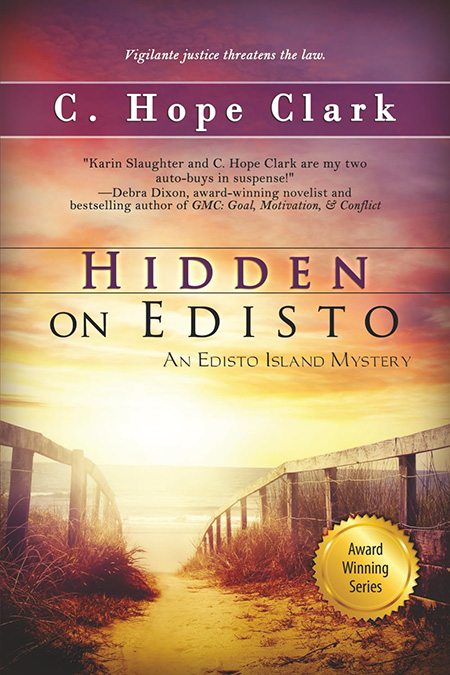
Hope: I keep up with the news at all levels for ideas. My main series takes place on the real Edisto Beach at the end of Edisto Island. I grew up not far from there. I go there and interview people often, but having worked the area in my federal employment, I was already familiar with the lay of the land. I love the area and the old-fashioned nature of it, although tourists are beginning to crowd it a bit now. But there is zero problem with details versus creative freedom. I work around the reality and use real streets and venues. The locals love it. The small local bookstore sells thousands of the books.
WOW: That must make your readers feel so connected to the series. When it comes to writing the novels, what is your planning process like? Or are you more of a pantser?
Hope: Total pantser. I paint myself into a corner with each and every book, but that is the beauty of it. That makes me dig down deeper and get more creative. My husband has a line he throws at me when I get stuck. “Is this the worst book you’ve ever written?” I said it about one book, and he reminds me of it whenever I’m thinking I’ll never figure out a plot. But I think pantsing makes me more creative. The one time I outlined, I had to throw it away after chapter three because I’d already deviated and gone in another direction.
WOW: What a great perspective on pantsing. How do you schedule your days? Or do you schedule your time for writing?
Hope: I retired from federal service at age forty-six to write full time. However, I vowed not to have “hours” when I wrote. I do, however, make myself write 1,000 words a day when I am on deadline. And I do two books a year. I could do three, but that would be pushing things a bit. Two books gives me breathing room for the unexpected in my life (like Covid that I recently had to endure for almost two weeks). But writing comes first after family, and my family knows it. The house can get dirty, the weeds grow, and the laundry piles up, but I will get my word count in. Also, FundsforWriters is a daily thing, researching and gathering information and plugging it into newsletters. It’s all habit now. But I feel like I haven’t brushed my teeth if I haven’t written that day.
WOW: That is a sure sign you have built a habit. As someone who often struggles with character development and making sure my characters stand out as their own person, I wanted to find out about your process. How do you make each of your characters so uniquely them?
Hope: You have to fall in love with your story and characters to do that. You can tell a story or you can live the story as you write it. I envision these people daily. I live with them. Often, I joke about one day getting dementia and forgetting the world around me, but I’ll be fine if I can just get lost in the worlds of the stories I’ve written. It takes effort to step back and look at all your characters and take honest stock of whether they stand out, each in their own way. Think of all the characters in shows like MASH, or Two and a Half Men, or any show, for that matter. No two characters are remotely alike. In looks, movements, dialogue, history, etc. It’s not hard if you take it seriously.
WOW: It’s true! Seeing them as unique is essential. When do you call a novel done? How does it usually take form from beginning to end?
Hope: After twenty-three novels, I can write a fairly decent first draft. I have always edited as I go. However, I must do a dozen edits afterward, too. I could do two dozen and still change things, but I stop when it’s down to changing things that are relatively fine as they are. After you’ve written a few novels, you feel it. However, that said, I had to do major rewrites on my 11th Edisto Mystery after my publisher had problems with the antagonist. That humbled me. You can always grow and improve.
WOW: Growing is always a good thing. Has your newsletter helped you build your readership? Do you think that should be the goal of any writer starting a newsletter? Why or why not?
Hope: Yes, my newsletter has helped, but not all of my readers are writers. So now, it’s more word-of-mouth, librarians and bookstores spreading the word. I have a decent, solid base of readers now and some long-time fans who are great to me. Yes, a writer needs a newsletter, but the problem is to want to write it and say something worthwhile in it. A lot of newsletters out there say little other than this is what I am doing, and buy my book. The reader needs more than that. I reflect on life, and I have a rather clipped way of doing it. So, I guess show a little personality. I have a lot of Substack newsletters that come to me, and, honestly, a dozen of them could be written by the same person. I’ve been deleting a lot of them.
“I pay freelancers to write articles for FundsforWriters (I pay $100 for 600 words). Over half the submissions I am receiving now are AI-written. The articles I like for FFW require personal experience, and AI cannot make that up.”
WOW: I have noticed the same with newsletters. With AI on the rise, I’m sure you have some thoughts about that technology. What place does AI have in any writers’ career or creative process, if at all?
Hope: In the creative process, none, and I’m adamant about that. If you cannot plot, if you cannot find the right word digging around a thesaurus, if you cannot describe a setting without using AI as a crutch, quit writing and let those who are writing from the heart continue. Research is one thing. Creative usage is another entirely. When it comes to commercial writing, that’s up to a business. They are hiring AI editors now. That’s another world entirely. Website copy, product copy, advertising copy… if you like AI, so be it. I pay freelancers to write articles for FundsforWriters (I pay $100 for 600 words). Over half the submissions I am receiving now are AI-written. The articles I like for FFW require personal experience, and AI cannot make that up. And if someone claims personal experience, I expect to see links to prove it. Otherwise, I reject, just to be on the safe side. I’ve been called unfair for that, especially by new writers, but there are thousands of other markets out there. I stand fast with the rules on FFW because I have readers who’ve followed me for two decades. I owe them to be true.
WOW: I think that’s completely fair! How do you think AI has changed our writing world?
Hope: It has taken away the easy assignments in the commercial world. It has empowered creative writers who don’t want to work as hard or who want to work faster and faster. Everyone thinks nobody can tell. I foresee one day, when AI gets savvy from being trained on so many books, that there will be some good books. But I also see readers not wanting to read something that a machine generated. They still want to know the author. I don't want to read something mechanical, even if it is good. I want to feel what a human cobbled together by the sweat of their brow. But AI has made a good many people writing whores. There, I said it.
WOW: Ha! I love it. Personally speaking, I feel there is a danger in how quickly AI has been embraced by society. What do you think about how it’s influenced our world today?
Hope: It is efficient in a lot of ways. People follow the path of least resistance. All we can do is follow our own beliefs. I will avoid customer service that is AI-driven, and I will never knowingly read an AI story. If I learn later that I have been duped, I will never read that author again and will tell others I know about the experience. But we can’t control this train. We can only choose whether to ride it.
WOW: I feel the same. What are you working on now that you can tell us about?
Hope: I am working on Book 14 of The Edisto Island Mysteries, tentatively titled Edisto Lethal. It is scheduled for Spring 2026. And I regularly write and present work for Writer’s Digest.
“Success can come, but it rarely is huge, and it doesn't happen overnight. You literally have to be in love with writing. Not publishing, but writing. Anybody can publish. Not everyone can write.”
WOW: You keep busy! Are you currently accepting articles for your newsletter? And, if so, what kind of topics are you open to or want to read?
Hope: Yes, always, though I have booked through February 2026. I am open to writers who can talk about something unique they were successful at in earning a living. That usually means that new writers don’t have enough to share yet. Those successes can involve publishing, freelancing, contests, and/or grants/residencies. They need to have links to examples and websites that confirm what they write about. Generalizations and feel-good theories don’t cut it with us. We are called FUNDS for writers for a reason.
WOW: I hope people submit! Any lasting thoughts you’d like to share?
Hope: You have to love this business to last in it. Success can come, but it rarely is huge, and it doesn't happen overnight. You literally have to be in love with writing. Not publishing, but writing. Anybody can publish. Not everyone can write.
WOW: What wonderful lasting thoughts. Thank you so much for joining us, Hope!
If you are interested in writing for FundsforWriters, visit their submission guidelines. You can also sign up to receive the free newsletter on the same page. To find out more about C. Hope Clark’s mystery series, visit her author website at chopeclark.com.
***
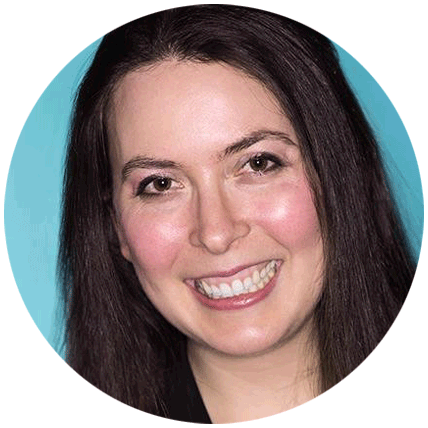
Nicole Pyles is a writer living in Portland, Oregon. Her writing has appeared in Sky Island Journal, Arlington Literary Journal, The Voices Project, The Ocotillo Review, and Gold Man Review. A poem of hers was also featured in the anthology DEAR LEADERS TALES. Her short story, “The Mannequin of Lot 18,” was nominated for Best American Science Fiction and Fantasy for 2024. Since she’s not active on social media very much, stay in touch by following her writing blog at World of My Imagination or her Substack, Nicole Writes About Stuff.