|
|
         |
|
|
 |
|
|
| |
|
|
| |
|

We had an open topic this season. Our only guidelines were that submissions be nonfiction with a minimum of 200 words, and a maximum of 1,000 words.
|
| |
|
THANK YOU TO OUR CONTEST SPONSOR:
It is the sincere desire of our sponsor that each writer will keep her focus and never give up. Mari L. McCarthy has kindly donated a prize to each winning contestant. All of the items in her shop are inspiring and can help you reach your writing goals. Write on!
|
| |
|
Note to Contestants:
We want to thank each and every one of you for sharing your wonderful essays with our judges this season. We know it takes a lot to hit the send button! While we’d love to give every contestant a prize, just for your writing efforts, that wouldn’t be much of a competition. One of the hardest things we do after a contest ends is to confirm that someone didn’t place in the winners’ circle. But, believe it when we say that every one of you is a true winner for participating.
To recap our current process, we have a roundtable of 12+ judges who score equally formatted submissions based on: Subject, Content, and Technical. If a contestant scores well on the first round, she receives an e-mail notification that she passed the initial judging phase. The second round judging averages out scores and narrows down the top 20 entries. From this point, our final judges help to determine the First, Second, and Third Place Winners, followed by the Runners Up.
As with any contest, judging so many talented writers is not a simple process. With blind judging, all contestants start from the same point, no matter the skill level, experience, or writing credentials. It’s the writer’s essay and voice that shines through, along with the originality, powerful and clear writing, and the writer’s heart.
Thank you for entering and congratulations to all!
 Now on to the winners!
Drum roll please....

1st Place: C. L.. Brenton
Carmel, California
Congratulations, C. L.!
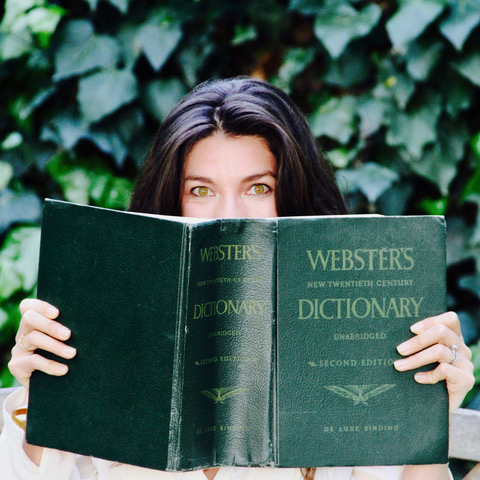
C. L.’s Bio: C. L. Brenton is a fiction author from Carmel, California, and an MFA graduate of Vermont College of Fine Arts. Her short stories about mothers on the brink have appeared or are forthcoming in J Journal, Colorado Review, Witness Magazine, and A3 Review among others. Discover more at clbrenton.com.
Printable View
RAINBOWS
By C. L. Brenton
You would think there would be thousands of them, the rainbows cast around his playroom by the cut crystal that twists in the uncurtained window, but they are finite, countable. One on the table sized for children, one on the rug, a ratty gray thing chewed up by our dog, one on the white wall beneath a painting of a giraffe, and one in my son’s hand. He is trying to catch it, carefully, opening and closing his palm.
He is three, small and observant, wearing a pink flowered dress that I wore through the summer I was pregnant with him. It was short on me then, especially as my belly grew taught and round, the perfect relief in a sweaty July, and now it fits him perfectly. Cream lace just brushes the floor, big ancient flowers and vines snake up the pleats, some prairie wife’s dress. He calls it his spinny dress, loves to whip it around himself, jumping wildly, so manic, so strong, the flowers twirling around army green dinosaur sweats he wears underneath.
No explanation satisfies or enlightens this three-year-old’s mind. Not light refractions, not light so white made up of all the colors, even colors we can’t see. He merely wonders why, when he closes his palm the rainbow stays on his knuckles.
“What do I do to catch it?”
What do you do, Sweet Boy? Why will it not let itself be caught?
And I know that this boy whose grandmother changes him out of his sparkly leggings because she thinks he’ll be “more comfortable” in jeans, whose doctor told him Frozen stickers were “kind of girly,” who follows me into my bathroom each morning and dons coconut chapstick and runs a soft makeup brush along his cheeks and chin and eyelashes and hair, this boy whose aunt wonders aloud if he’s going to be trans or gay or some version in between — is indefinable. He is not gender, this is not spectrum, he is human. He is so gloriously human he’s incapable of being anything else.
He lies quietly on the floor, blue-green eyes investigating this rainbow, his hair blonde and untamed, untamable. Rainbows, I want to tell him, are rare in this world. Their beauty lies in their fragility, they are special, in the end, because they exist only for a moment.
What do I do to catch him here, to keep this wildness in his bones, to stop the world from doing what it does to all of us, to define him, to other him, to decide for him what he is or should or can not be? How do I hold him in this moment when he’s constantly wriggling from my grasp?
“What is it for, Mommy?” He asks and I think I know what he means. Why rainbows? Why here in his playroom? Why only sometimes when the sun is low and bright?
“To be beautiful,” I say.
And just as he closes his hands the clouds shift and the rainbow disappears from his knuckles.
“I did it.” He beams, tightening his grip, and holds his hand out to show me. I hesitate, certain of his disappointment when he opens his palm, but he pulls it back, holds it to my eye and I peer into the cavity of his fist.
“It’s beautiful.”
***
What C. L. Won:

2nd Place: Wendy Fontaine
Valencia, California
Congratulations, Wendy!
Wendy’s Bio:
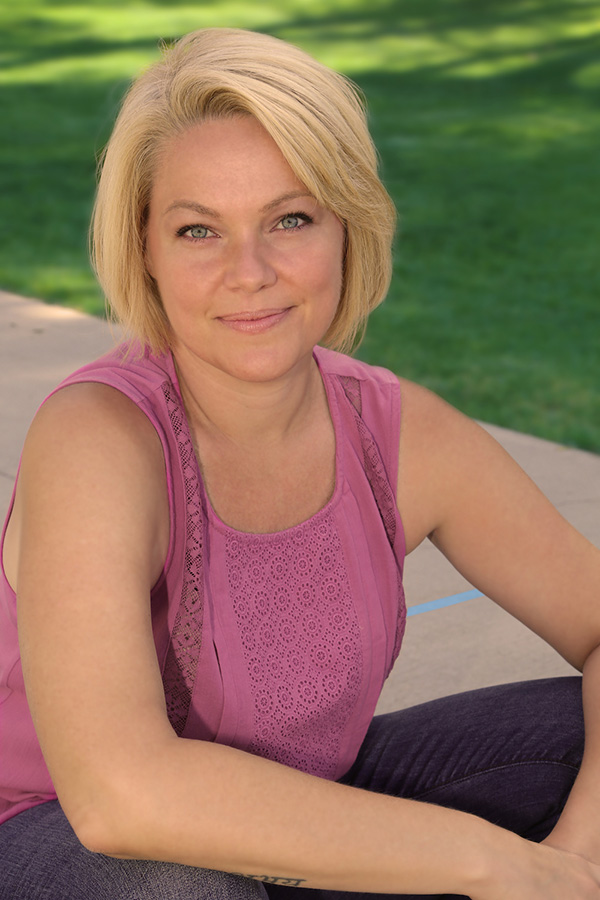
Wendy Fontaine’s work has appeared in American Scholar, Jet Fuel Review, Sweet Lit, Short Reads, Under the Sun and elsewhere. She has received nonfiction prizes from Identity Theory, Hunger Mountain, Streetlight Magazine and Tiferet Journal, as well as nominations to the Pushcart Prize and Best of the Net anthologies. She serves as the flash creative nonfiction editor at Hippocampus Magazine and works as a board-certified inpatient pharmacy technician.
Printable View
Ask Your Doctor if Empathy is Right for You
By Wendy Fontaine
Brand Name: Empathy
Etymology: from the Greek empathia: “em” meaning “in; “pathos” meaning “feeling”
Drug Class: Reversal agent (counteracts the effects of toxicity, sedation, fear, judgement and shame)
Indications:
Empathy is indicated for the symptomatic treatment of patients with mild, moderate or severe lack of compassion for others.
This may include chronic heartlessness toward immigrants, protestors, women who work outside the home, families experiencing poverty or homelessness, adolescent victims of school shootings, transgender athletes, urban voters, people of color, and anyone else the patient perceives as different or lesser than themselves.
The efficacy of Empathy in patients with mild to moderate cases has been established in placebo-controlled trials throughout history, including the American Civil War, World War II, California wildfires, Hurricane Katrina, the terrorist attacks of 9/11, and the 2020 covid-19 pandemic. In most cases, the compassionate effects of Empathy were fleeting, as the half-life of the drug appears to be short. Additional studies are needed (and inevitable).
Empathy may also be effective in patients with severe lack of compassion, although increased dosage may be required.
Mechanism of Action:
Empathy works by activating the brain’s system of mirror neurons, which active when a person is either performing a specific action or observing that action being performed by others. For example, a woman in Texas supports her state’s abortion ban until her daughter suffers pregnancy complications of her own, after which they travel to a different state to find adequate reproductive care.
The ability to feel compassion for others normally develops in children at the age of one or two, as their awareness of others begins to grow. Symptoms of early-stage compassion include hugging, apologizing, noticing when others are hurt, or crying when someone else is crying.
However, a percentage of people will grow up without this ability. They may laugh when a coworker gets fired or pretend not to notice as an elderly woman struggles with her grocery bags at the supermarket. They may look away when ICE grabs a mother from the school drop-off line. They may become husbands or wives, best friends or neighbors, professional athletes or reality TV stars. Some may even become president of the United States.
Clinical exams:
Empathy may cause heartache and changes in consciousness levels, which could interfere with a patient’s previously established worldview. If taken while watching the evening news or scrolling social media, Empathy may cause depression.
Contraindications and precautions:
Studies have shown no contraindications for Empathy, meaning it works for everyone – whether they want to believe that or not.
Patients who think it’s funny to pose in front of the sign to “Alligator Alcatraz” or to hear the President say “Quiet, piggy” to a reporter might need a higher dose of Empathy. For those who think ten-year-old rape victims should be forced to give birth, who refer to women who are not mothers as “childless cat ladies,” who were at the Capitol building on Jan. 6, 2021 or marched through the streets in Charlottesville, Virginia, chanting “Jews will not replace us,” additional therapeutic exposure may be required.
Some drugs have shown potential to enhance the effects of Empathy. They include volunteering in your community, listening without judgement, meeting people with different backgrounds, and asking questions rather than relying on assumptions.
Routes of administration:
Oral: Have a discussion with the manager of a local food pantry, ask them how many people they serve each day now that food prices are up 30 percent since the pandemic.
Topical: Find better news sources, then do a deep dive on gender reassignment surgery for minors or late-stage abortion. Learn that both are extremely rare, undertaken only when the subject is in incredible emotional pain. Imagine your own child in that kind of pain. Imagine them hating their body or feeling lost inside their own skin. Imagine the heartache of learning your fetus will not survive birth or has already died inside the womb. Ask yourself, what would I do in this situation? How would I want to be treated?
Inhalation: Take deep breaths. It’s hard to ask yourself these difficult questions. It’s hard to let down your guard, to realize there is far more gray area here than black and white. Life is complicated and scary, and everyone is trying to do the best they can with the circumstances they’ve been given. Everyone, like you, is trying to survive.
Parenteral: If America’s lack of compassion makes you queasy or nauseous, try injecting Empathy intramuscularly or intravenously. Consider using it subcutaneously; really let that Empathy get under your skin.
Rectal: If all else fails, shove it up your ass.
Missed Doses:
If you miss a dose of Empathy, don’t worry. We all forget our better angels sometimes. Just take the next dose when it is due. Do not take two doses at once. Uncontrollable crying may occur.
If you have trouble remembering to take Empathy, consult a friend or a mental health expert for support. Everyone needs a little help sometimes.
***
What Wendy Won:

3rd Place: Alexis Ward
Lake George, New York
Congratulations, Alexis!
Alexis’ss Bio:
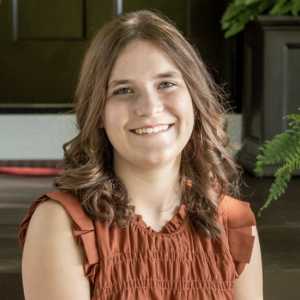
Alexis Ward is a writer of comedic, dramedic, and satirical creative nonfiction, and she finds great fun in experimenting with form. You can find many of her fiction and nonfiction pieces in The Laurentian Magazine, the undergraduate literary mag of St. Lawrence University in Canton, NY. She is currently pursuing an MFA in Creative Writing at Emerson College in Boston, MA. This is her first-ever submission to a writing contest!
Printable View
To the girl I met on the ramp,
By Alexis Ward
after my college choir sang the alma mater at that stupid faculty event and I was boiling, from sun seeping into concert black and from the way that she, that girl I’d known for years, greeted me—as I happily bounded over to my choir-mates to say hi, with freshly-done hair and those diamond studs in my ears which I loved but only wore for formal occasions—the way she welcomed me not with “hi,” or “hello,” but with “is that the same dress you wore on Sunday?” when it so, so obviously was not (this one had floral embroidery; Sunday’s was smooth and plain), and from the way she sneered at me, and from the way she giggled with her gal pals right after, and from the way she bounced and swayed and smiled with each soaring note she sang—like a chickadee, merry and weightless—standing tall and proud, as if she’d helped me, found me naked on the street and clothed me with sage wisdom, while I shrank beside her, raggedy and unfashionable, as a long-lost echo bounced across my skull, screaming you know nothing of fashion or appearance, nothing of womanly code, and you will never be a girl—you will never be a girl—you will never be the pretty princess reigning atop the jungle gym but the pauper hunkered beneath the slide, trading Pokémon cards with Jack and Bradley; you will bleed and ache, be endowed and pursued, and you will grow into a woman but you’ll never be a girl, and I cursed myself for packing two black dresses of near-identical length, and I cursed my mother for passing that flowery dress down to me, and I cursed myself again for believing in “girlhood”: that Disney Channel trope, that secret club with a guaranteed network of aesthetics-based friendships and free tampons hiding the gruesome truth, that deep down we’re all bitches and there is no love; until I bumped into you—literally bumped into you—as you left the dorm and I entered, and you told me I looked stunning, which may have been a bit of a stretch but nonetheless snuffed the blaze in me:
I must apologize, for in my memory you are but an amorphous blur. I cannot recall what you wore, or what you looked like. I can only remember that you were beautiful.
***
What Alexis Won:
 RUNNERS UP:
Congratulations to the runners-up! It was very close, and these essays are excellent in every way.
Click on the titles to read:
Under the Boat by Katie Youmans, Lincoln, Nebraska
Big Fist: What to do When the US Begins Bombing Your Immigrant Husband's Home Country by Nicole Brogdan, Austin, Texas
Boys and Noise by Elizabeth Hoban, Hampton, New Jersey
Disappearing: A Recipe for Anorexia Nervosa by Deborah Svec-Carstens, West Des Moines, Iowa
Feelings Feeler Job Description by Kendra Ryan, Philadelphia, Pennsylvania
Look Both Ways by Hallie Marbet, Bracciano, Italy
How Does the Heart Function? by Paula Kupchak Hall, Calgary, Alberta Canada
HONORABLE MENTIONS:
Congratulations to our essay contest honorable mentions! Your essays stood out and are excellent in every way.
When the Forecast Fails by Wendy Slattery, Bloomington, Minnesota
Hospice by Annette Leavy, Philadelphia, Pennsylvania
To My Daughter’s Mother by Elizabeth Bobst, Carrboro, North Carolina
Equality Opportunity Orgasms by Nancy Graham Holm, Arrhus, Denmark
A Lost Letter by Alana Beth Davies, Swansea, United Kingdom
Shadow Puppets by Marlene B. Samuels, Ph.D., Chicago, Illinois
The Logic of Noise by Veronica Sirotic, Long Island City, New York
My Future Fast Twitch Ass by Julie Lockhart, Port Townsend, Washington
Breathing Machine by Carolyn Campbell, New Mexico
How I Failed (yet nailed) my vacation by Frances Figart, Flag Pond, Tennessee
What the Honorable Mentions Won:
IN CLOSING:
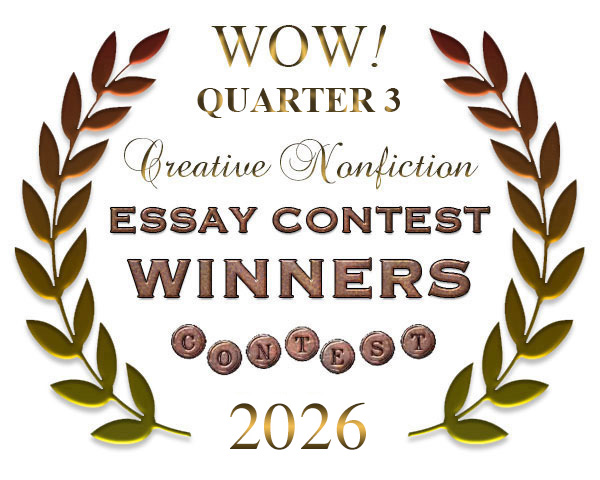
This brings the Q3 2026 CNF Essay Contest officially to a close! Although we’re not able to send a special prize to every contestant, we will always give our heartfelt thanks for your participation and contribution, and for your part in making WOW! all that it can be. Each one of you has found the courage to enter, and that is a remarkable accomplishment in itself. Best of luck, and write on!
Check out the latest Contests:
https://www.wow-womenonwriting.com/contest.php
|
|
|
|
|