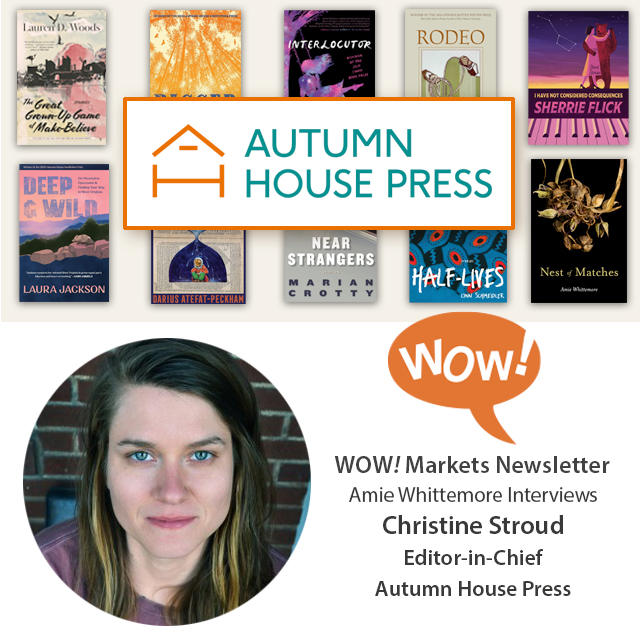
After finishing my MFA in poetry in 2010, I spent the next six years sending out varying iterations of my graduate thesis to poetry collection prizes—the main way poetry manuscripts find their way into the world. As the manuscript evolved, it became less and less the book I thought it was going to be and more and more the book it needed to be. And, while I trusted this process, I was feeling gloomy about publishing prospects as my submission spreadsheet piled up with rejections.
Fortunately, when I was in the “depths of despair” as Anne of Green Gables might say, Christine Stroud, then Managing Editor at Autumn House Press, emailed me about a chapbook manuscript I’d sent to their (now defunct) Coal Hill Chapbook Prize. She let me know they weren’t going to publish it, but it was the second chapbook I’d sent them that came close; did I have a full-length? I had recently finished editing my full-length for what felt like the 100th time, and said sure, sending it off to her without overthinking it—I was sure another “no” awaited me.
A few weeks later, I took a call from Christine in a Walmart parking lot that changed my life; Autumn House Press was going to take my first book, Glass Harvest. Since that auspicious phone call, I have gotten to read books by my impressive press mates, sometimes reading alongside them at events, and have gone on to work with Christine on my third collection, Nest of Matches. Autumn House is truly a special press and it was a treat to virtually sit down with Christine Stroud as she celebrates ten years as Editor-in-Chief.
WOW: Thanks so much for chatting with me, Christine! Even though we’ve been working together for ten years now (how is that possible?), I realize I’m not familiar with your journey to Autumn House Press (AHP). When did you start working for AHP and how has your role evolved?
Christine: Of course, Amie, it's always a delight to talk to you. And I’ve actually been thinking about your first book, Glass Harvest, quite a bit recently. Your book was the first collection I contracted, and it came out not long after I took on the role of Editor-in-Chief. Which is to say: your first book also holds great significance for me, and the fact that we’ve gotten to continue working together has been a joy.
My journey started in 2012, when I served as the fall intern at AHP while I was in graduate school. After the internship concluded, I was hired as a part-time assistant editor while I finished up my degree at Chatham University. Once I graduated with an MFA in poetry and a concentration in publishing, I planned to go on the job market, but Michael Simms, founding editor of Autumn House Press, graciously saved me the trouble of having to update my résumé and promoted me to the full-time role of associate editor. Michael retired from the press and board completely in early 2016 and I took the helm as Editor-in-Chief in March 2016 (ten years in two weeks!). So, a meteoric rise for me, and I always say it was a combination of hard work and incredible timing on my part.
WOW: Oh, I love that Glass Harvest marks a turning point in both of our careers! I’m so glad that hard work and timing guided you to this role. I know that AHP has had several big wins in recent years: last year, the Association of Writers and Writing Programs’ awarded you the Small Press Award, acknowledging the hard work, creativity, and innovation of the press, and Bittering the Wound by Jacqui Germain won the 2024 Kate Tufts Discovery Prize. Congratulations! Why are these kinds of awards significant for small independent presses, like Autumn House?
Christine: Thanks, yes, it was a really good year, and I’ll never tire of the video recording of the Claremont Graduate University award committee’s call informing Jaqui she was the winner. I get all misty any time our authors win an award; not only is it validation of the hard work that they’ve done, but also the long-term importance their book has on the literary world. Also, in many cases, these awards come with financial support that allows our writers much deserved resources that are becoming harder to secure as funding for the arts decreases. It’s also exciting for the press as these awards, in particular the AWP Small Press Awards, help us connect to new writers and readers who may not know about the press.
WOW: I remember in grad school reading for Crab Orchard Review, and marveling at how certain poetic trends would emerge, such as the word “cocoon” showing up frequently, or a proliferation of parentheticals. What are some trends you’re noticing in the work you see coming through, be it in terms of subject matter or craft choices?
Christine: I love this question, and it’s so true. Last year in fiction there were a lot of dead husbands, which was frankly refreshing as we typically see a lot of dead moms (we called it the Disney effect). A few years ago, it felt like every other poetry submission referenced kintsugi or compared the sunrise to an egg cracking over the horizon (and look, kintsugi is an incredible metaphor and a yolky sunrise is a great image, so this isn’t meant to be dismissive). More recently in poetry I’ve seen poets engaging a lot with formal verse, which I am a big fan of—give me all your Golden Shovels!
“AHP books are grounded in the personal—whether that be a literal personal experience in our nonfiction or well-developed characters in our fiction—but consistently engaging with and looking outward at larger cultural issues.”
WOW: Well, I’m glad that the dead dads are catching up with the dead moms, though that’s a sentence I never thought I’d write. And, you heard it here first, folks: send those poetry collections dazzling with golden shovels to Christine! AHP publishes poetry, nonfiction, fiction, and anthologies. How would you describe the press’s aesthetic across these genres? What advice would you give someone entering one of your contests?
Christine: I wouldn’t say we have a singular aesthetic necessarily. We publish a mix of experimental and more traditional titles. I’d say the unifying element of AHP books are that they are grounded in the personal—whether that be a literal personal experience in our nonfiction or well-developed characters in our fiction—but consistently engaging with and looking outward at larger cultural issues. Whether that be climate change, gender identity, sexuality, racism, we are just dedicated to publishing books that are engaged with the real issues affecting contemporary society.
As far as what I would suggest to someone considering submitting to us: read one or two of our books and read our website so you have a sense of what we can do for you as an author.
WOW: I love that AHP balances the personal and political in this way and is one of the reasons I’m so proud to call it my home press. Speaking of, I had such a wonderful time working with you on Glass Harvest and Nest of Matches, but I am curious about how you would describe the editorial process AHP offers authors—what would you want a newly signed author to know?
Christine: Thanks, I had a wonderful time working with you as well. You were thoughtful and flexible; you were open to making changes but knew when to push back if an edit didn’t feel right. I really value that level of trust with an author.
And what I want every newly signed author to know: We’re on your team. We want this book to succeed as much as you do, and we are here to elevate not alter your voice. For us, edits are always suggestions, never demands, and we view our investment in the editorial process as proof of our deep care for your book.
WOW: I love this idea of “elevate not alter” and I think that’s how it should be when an author finds their dream editor/press. One of the parts of the publishing process that many writers are curious about is the design element. You’ve got a wonderful slate of designers for your books. What kind of say does an author have in book design?
Christine: Yes, we have some really wonderful designers in the AHP family, and I’m grateful for the work they do and the perspective they bring to the production process.
Our authors have quite a bit of say in the cover design. We begin the conversation by asking an author if they have a piece of art in mind, while asking them to be mindful of permission rights. Famous pieces that appear in museums are often going to be cost prohibitive for a small press like us, whereas a piece by an emerging artist might be more affordable. We also ask authors if there are any colors they like or don’t like, if they have a favorite font, etc. We then share all this information with our designer and then they create three to five options. We’re typically able within that first round to find a cover that works with very few adjustments. Though sometimes seeing a first round of covers might help the author realize that they want something very specific and we work through another few rounds of covers. We also share cover options with the marketing folks at our distributor, as they offer insight into issues that might not be working well from a sales viewpoint. We’ve never gone to print with a cover an author wasn’t excited about.
“We’re on your team. We want this book to succeed as much as you do, and we are here to elevate not alter your voice.”
WOW: I think it’s so key for authors to feel excited about their cover as, especially for poets, promoting your book is a team effort, and an author needs to feel good about championing their own work—a gorgeous cover helps take the edge off self-promotion anxiety. Which brings me to the challenging question of marketing. How does AHP support authors in marketing their books? What’s one piece of advice you’d give an author launching their book with a small press?
Christine: For each book, we create a personalized marketing plan that highlights what and when we’ll be doing things like sending out review copies, querying editors about interviews, sharing info on social media, nominating books for post-publication books prizes, etc. As a small press, we depend on our authors to spearhead readings, such as book launches, but we do try to host all our authors in Pittsburgh for events if feasible, and brainstorm with authors what other events they can do in their community and beyond to connect with readers.
As far as advice, again, remember, you and your publisher are a team. You should always feel comfortable asking questions, and when it comes to marketing, be sure to ask what your press is doing and what you can do. Don’t just assume they’ll be doing everything but also understand that your publisher is doing a lot of work you may not see on the day to day.
WOW: I think that asking questions is so important. There were certainly times, especially with Glass Harvest that I was feeling stumped on what to do for promotions and asking you for advice/leads was always useful! What forthcoming titles are you excited about for 2026?
Christine: All of them, of course! As a small press, we publish six books a year, and so I have enough room in my heart to love them equally. Right now, I’m just so excited to see our Spring 2026 books come out next month.
WOW: Spoken like a proud parent! I know you are also a talented poet. How do you balance your editorial work with your creative work?
Christine: Ah, thank you, but honestly, I’m not sure I do balance it. I was just talking about a line in Mary Oliver's A Poetry Handbook, where she explains that she could never be a teacher of poetry because she knows she would find it endlessly interesting and that would have distracted from her creative process. I definitely find my work endlessly interesting and often find that it is challenging for me to sustain the momentum for my creative practice. I have a writing group where we get together just to write, and that consistency it helpful. I read a lot and consider that a part of my creative practice. I think an artistic practice is so personal, so I say find whatever works for you and do it. There’s no one way to be a writer.
WOW: I think of that Oliver quote often too and have seen that I channel creativity into my work as a teacher more often than I get to the page these days. I think the (im)balance is always in flux—sometimes we are called to create our own work, sometimes to support others’ creativity. There certainly is “no one way.” And, finally, we’ll wrap up with a fun question: if you were a poetic form, what poetic form would you be? I’d like to be a cento, as I like to think I contain multitudes (or maybe it’s the Libra in me refusing to make a decision). What about you?
Christine: Obviously, this is my favorite question. I think I’m probably a sonnet. I can be versatile or rigid; I can expand or contract. A solid Virgo. Also, I love to talk about love.
I’m so thankful to Christine Stroud for sharing about her experiences as Managing Editor at Autumn House Press. This press is truly dedicated to supporting its authors and publishing a wide range of voices. Hopefully readers will benefit from getting this insider’s perspective on this award-winning independent press!
Find out more about Autumn House Press’s submissions and contests here: https://www.autumnhouse.org/submissions/.
***
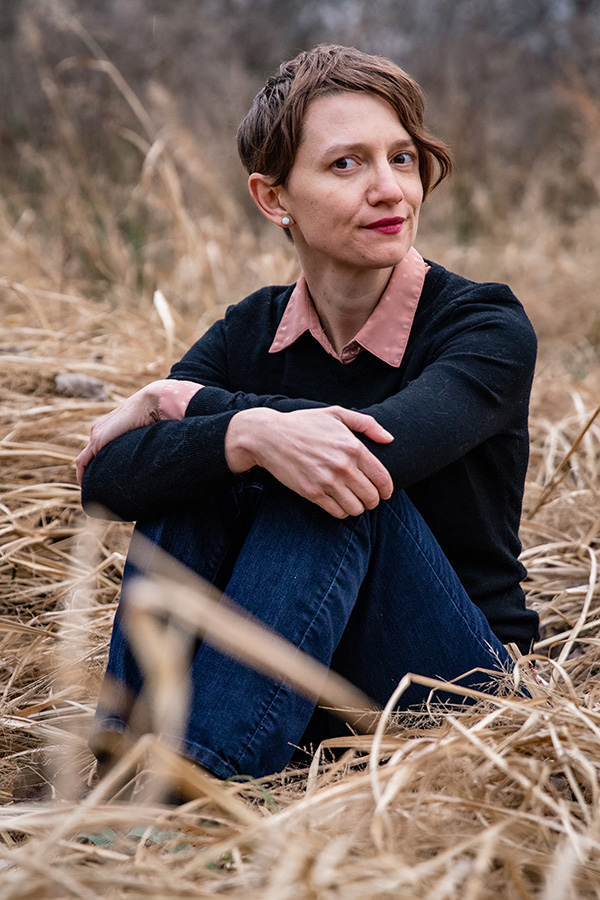
Amie Whittemore (she/her) is the author of four poetry collections, most recently the chapbook Hesitation Waltz (Midwest Writing Center, 2025). She was the 2020-2021 Poet Laureate of Murfreesboro, Tennessee, and an Academy of American Poets Laureate Fellow. She is a creative writing and yoga instructor. Learn more at amiewhittemore.com.