This blog is now located at https://muffin.wow-womenonwriting.com/. You will be automatically redirected in 30 seconds, or you may click here. For feed subscribers, please update your feed subscriptions to https://muffin.wow-womenonwriting.com/feeds/posts/default.
The Muffin FTP Blogger Migration
I knew this would happen sooner or later. Blogger is no longer supporting FTP blogs, which is what The Muffin is. Their reason is "FTP remains a significant drain on our ability to improve Blogger: only 5% of active blogs are published via FTP--yet the percentage of our engineering resources devoted to supporting FTP vastly exceeds that." So we have to "migrate" the blog to a Blogger-managed URL, which we will be attempting this Monday, April 12. This news isn't sitting well with FTP bloggers. Imagine publishing a blog for years on your own server, hosting (owning) your own files and posts on your own server, and then having to move your entire blog to a new URL, and losing the ability to control your property. It's like owning your own home and having someone say that you have to pick up and move your house to another location with another address, and all of a sudden you're renting it, instead of owning it. Not to mention the complications! The Muffin has four years worth of posts, high traffic, SEO, and links to our URL. Now, all The Muffin's posts will have to be redirected to a new URL. I can't imagine this will run smoothly. And what happens to our RSS feed, our traffic to our site, and everything else? I'm not tech savvy enough to wrap my head around this and I'm disappointed in Blogger/Google for making this decision. Another truly sad part about this is it affects users in China. China's "Great Fire Wall" blocks their ability to use Blogger blogs, and their only way around it was by using FTP blogs. Ugh. The list of grievances is long. The comments at the bottom of this post explain some of the other concerns FTP bloggers have with the migration. Over the next couple of days we'll be working out the kinks, so please bear with us. As with anything, change is always scary but it forces us to move forward. Sometimes situations we view as negative in the beginning can have positive results in the long run. Who knows? Perhaps we'll migrate to their host and find it has more functionality, or perhaps we'll move to Wordpress like we've always wanted to do, and this is just the first step that will propel us toward our goals. We'll just have to see what happens as we dig in. Wish us luck!
The Professor and Other Writings - A Review
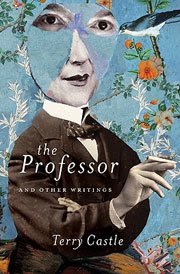
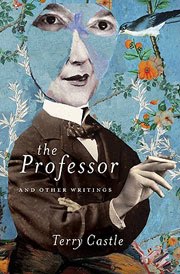 The Professor and Other Writings The Professor and Other Writings is a collection of seven essays by author and professor, Terry Castle. As she wrote in the ‘Author’s Note’ at the front of the book, some of the pieces had been previously published, and in this book, appear in the order in which they were written. Castle added, “Having labored in the dusty groves of academe for over twenty years, I felt---as a new millennium unfolded---a desire to write more directly and personally than had previously been the case.” Intriguing photos serve to introduce, as well as illustrate the theme of each autobiographical essay. Castle unveils her perspectives on love, family, relationships and sexuality, all accompanied by her wicked wit. Nothing has been held back, especially in the title essay, ‘The Professor’, in which she relates her relationship with a female professor. There were times when reading through the book was overwhelming, with the sheer amount of scholarly information that backed personal details. One essay, ‘Courage, Mon Amie’, is a fascinating study of the author’s obsession (or ‘war fixation’, as she puts it) with military history, inspired by her desire to find the gravesite of her great-uncle, who died during WWI. As British-born Castle makes the rounds of France and Belgium, you’re drawn into her search. There are detailed descriptions of the cemetery, trenches, tiny museums, and other military haunts she visits, sometimes alone, other times with a relative. While it may be off-putting to some readers, the author’s passion for war and its trappings is phenomenal, especially as she struggles (as many of us did back in 2002) with myriad emotions in the aftermath of the 9/11 attacks. Another essay, ‘Home Alone’, deals with America’s captivation with design (or shelter) magazines, and the desire to create a space, some sort of secured home of one’s own. Castle admits her own ‘shelter-lit addiction’, relishing in flea market finds and eagerness to get her hands on the latest mag candy. She asserts that it “is all about consumption, luxury goods, and the pipe dreams of upward mobility” that drives one to seek this decorative nirvana. Enhancing her dead-on commentary are quotes from American interior design experts Elsie de Wolfe and Mario Praz, and those from the publishing staff of some of the magazines mentioned in this piece. This essay was a much easier read than the one above. In conclusion, if essay collections laced with scholarly insights and biting humor are your cup of tea, then you’ll want to give The Professor and Other Writings a look. Labels: book review, essay, essay writing, Terry Castle, The Professor and Other Writings
Friday Speak Out!: Why to be a Writer, Guest Post by Amy O'Neil
‘Why’ to be a Writerby Amy O'Neil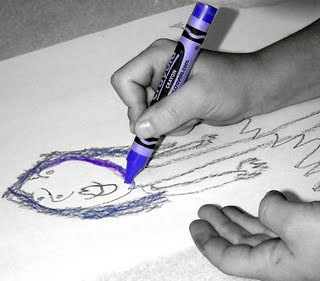 Look on the internet and you will find a million different sites talking about ‘how to draw’, but how many of them discuss the all important question of why to draw? The same goes for writing.
I found myself asking this question today, right before I was about to embark on a commission for four large drawings.
I found a few vague answers, such as “We draw to express our creativity and expose it to the world”.
But today these answers didn't really satisfy. What is your creativity, why do you want to expose it, and why does the world need to be exposed to it? What does it ultimately achieve?
Is this just a stock phrase that merely sounds like it could be answering the question, or is it the truth of why to draw?
In our present times we have access to people’s talents, skills, stories and creations in the billions over the internet. We are literally swamped with exceptional and puzzling works of the mind, and not always in a good way. Can your work really contribute anything meaningful? Is the reason to create really ‘to add something to the world’? Or is it to feel like your existence is necessary?
It's a hard pill to swallow when you consider that the world would be okay if you weren't here, that literature would still be great and that art would continue to shock and delight. Films would still be moving and extraordinary, food would still be delicious, music would still sound wonderful, the earth would still spin.
So is it important that you draw, or write?
For me, today, the truth was no.
Is it essential for our already overwhelming culture?
Chances are slim.
So why do it? It's the same question as why bother existing. We exist because we exist. Existence is not necessary but it's a gift.
To be able to be here and taste delicious food, and read wonderful books, and watch breathtaking films and have complicated relationships is a one-hundred percent bonus.
Why draw or write? It is part of the gift. You do it because you can, because you're here and you have thoughts and opinions and were born into this tiny slither of time and place that nobody else was. And for some reason you fell into it; it happened, like when a flash of colour catches your eye.
So when you sit down to do that very important piece of writing today, or that ‘essential’ work of art, remember why you’re doing it. I mean, why you're really doing it.
Perhaps it’s because when you were a child you had an idea, and you decided to put it on paper because it seemed fun and natural, not because you were driven by adult fantasies of self-importance.
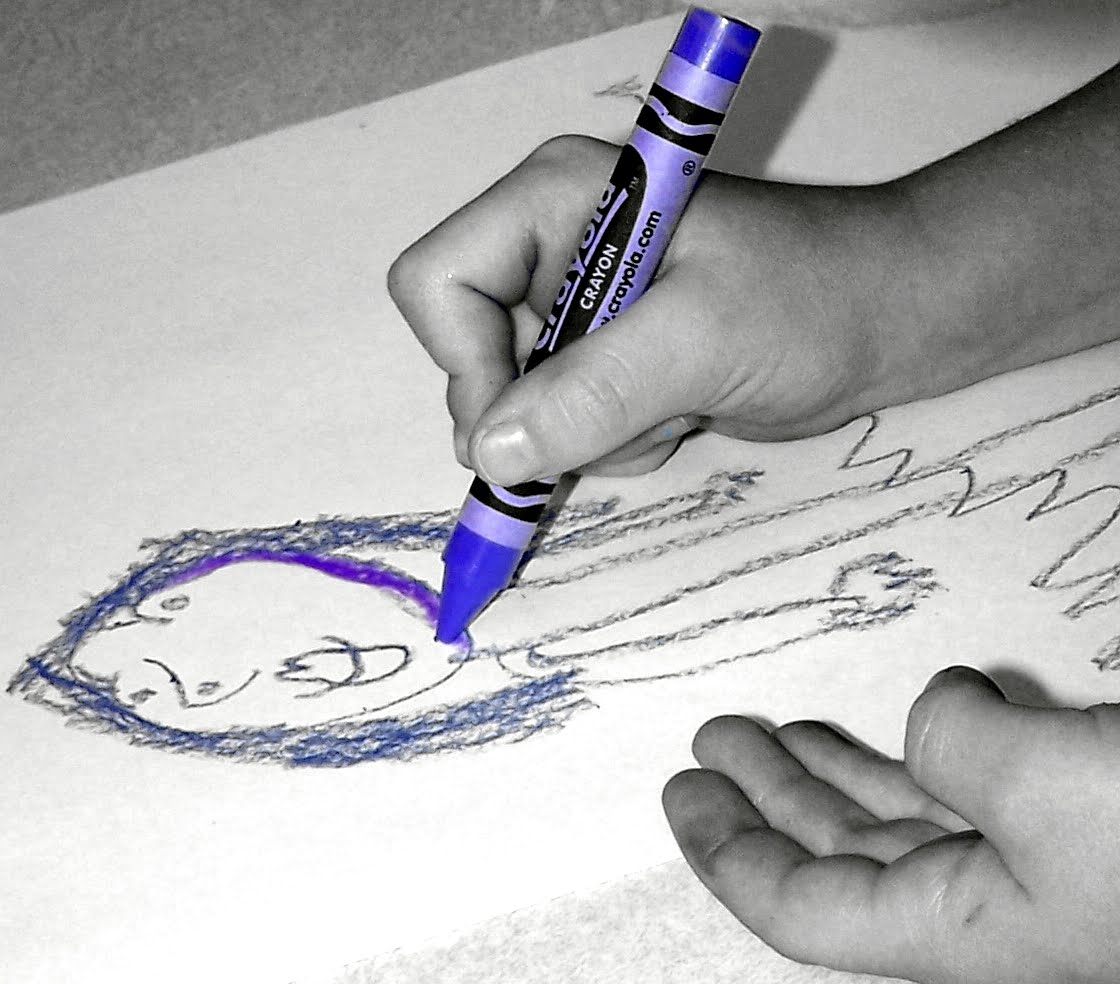
It is a gift. All you need to do is relish it. Photograph courtesy of D. Sharon Pruitt.
* * * 
Amy O'Neil has a BA in Fine Art from Chelsea College of Art and Design, which she completed in 2007. Since then she has been taking private commissions for drawings from photographs, but has found her interests have turned more towards short fiction writing. Her stories have been placed in several small competitions, as well as being recently short-listed for the Fish Short Story Prize. You can contact her at amygraceATgooglemailDOTcom.
~~~~~~~~~~~~~~~~~~~~~~~~~~~~~~~~~~~~~~~~~~~~ Would you like to participate in Friday "Speak Out!"? Email your short posts (under 500 words) about women and writing to: marcia[at]wow-womenonwriting[dot]com for consideration. We look forward to hearing from you!~~~~~~~~~~~~~~~~~~~~~~~~~~~~~~~~~~~~~~~~~~~~ Labels: Amy O'Neill, Friday Speak Out, writing inspiration
An Interview with Demand Studios Editor, Robyn Galbos
 We are lucky to have Robyn Galbos from Demand Studios with us today to answer some questions we've received about becoming a writer for them. She has provided some tips for applying and writing articles and information about some of the new Demand Studios programs, so let's get started! WOW: Hi, Robyn. Thank you for taking time out to talk with The Muffin about writing for Demand Studios. What kind of writers are Demand Studios looking for? Specific genres? Certain experience or college degrees? Robyn: Demand Studios is looking for all kinds of writers with a variety of backgrounds and interests. We are primarily looking for people with solid researching and reporting skills, and ideal candidates have had their work published in print or online. During the application process, writers must upload a résumé and a writing sample; the stronger the writing sample, the more likely the writer will be accepted.
WOW: So, writers can use their knowledge they gain from hobbies and other careers to write articles and make extra money on Demand Studios. What are two or three tips you can give writers who are applying for positions? Robyn: First, take the application process as seriously as you would for a full-time position. Because this is an independent contractor position, sometimes writers think that they don't need to try as hard. Upload a recent résumé that highlights your writing experience and any expertise you may have. Proofread your résumé for typos. Typos in a résumé are a red flag when you're applying for a writing position. Second, put your best foot forward with your writing sample. Take time to research the sites for which you are applying to write, and take note of the voice and tone of the writing. Attach writing samples that would fit well on those sites. If you don't have published work, try writing an article in the style of eHow, LIVESTRONG, Garden Guides or any other site you're interested in. Be sure to submit original work as your writing sample, however, and remember to proofread your submission for typos as well. WOW: Thanks for the tips, Robyn. Many writers can write 400- to 500-word articles quickly; and therefore, they write several Demand Studios articles a day in a short amount of time. What are some tips for writing Demand Studios articles in a timely manner? Robyn: The simplest answer is "write what you know." The more you venture into topics that are not your area of expertise, the more time you will take to research and write the articles. If you know a topic, you likely know where to find the most credible references. A word of caution: Even though you know a topic, resist the urge to write off the top of your head without researching. We require references for every article, and facts must be verifiable by the copy editors. I also recommend that writers master one format before moving on to others. Once you understand the guidelines and nuances for a particular format, you get in a rhythm and can work a lot faster. Finally, really take the time to familiarize yourself with all of the Demand Studios guidelines. This will help save time on rewrite requests. WOW: More great tips. It seems like if writers take time at the beginning to learn about the templates and different types of articles, they will work quicker and more accurately in a few months. Demand Studios allows writers to suggest articles they would like to write. Please explain to us how this process works. Are these articles paid the same rates as articles that Demand Studios assigns? Robyn: Writers may create their own assignments in Demand Studios, and approved articles are paid on a revenue-share basis. We are looking for titles that revolve around a topical theme while remaining evergreen. For example, articles around filing your tax returns are perfect in the early part of the year. WOW: Sometimes, Demand Studios editors have to send articles back to writers to fix. What are some of the most common reasons why writers get their work sent back to them? Robyn: Every article that is submitted through the Demand Studios publishing tools is edited and fact-checked by a copy editor, and we consider rewrites to be a natural part of the editorial process. Copy editors look at articles with the eye of a reader. If there are questions about clarity or facts, the editor may need to ask the writer some questions. The most common reasons for rewrites are unverifiable facts, guideline violations, unclear sentence structure, or vague statements. An editor may also send an article back if the article does not directly answer the question put forth in the title or is not specific enough to address the title accurately. Writers who study the guidelines, do research, and cite their sources likely will receive fewer rewrite requests. WOW: So, copy editors and writers work together to make the articles as clear and accurate as possible. That makes perfect sense! Many Demand Studios writers make an average of $15 an article, but there are ways to make between $20 and $80 an article. Please explain how writers can make more money per article and about your new specialty writers program. Robyn: Demand Studios has several levels of special assignments that we reserve for our best writers: that is, writers who consistently deliver high-quality articles written according to all applicable guidelines. These higher-paying opportunities are for Demand Media sites and for our partner sites and include premium assignments for our copy editors. We regularly review our creator base and look for these standout performers. WOW: It's nice to hear that hard work is rewarded, and there are chances to move up in the company while writing for Demand Studios. Demand Studios periodically has the program "Write for a Cause." What is this program and how does it work? When will you be offering it again? Robyn: Demand Studios partnered with First Book in December to donate new books to children across the country, and the program was such a hit that we revived it for two weeks in mid-March. For every eight Demand Studios articles published during the program, Demand Media donates one book to a child in need. Thanks to our writers and copy editors, we have been able to donate a total of 26,639 books to kids so far. I can't say for certain when we'll offer the program again, but I can say it's been a huge success, and I look forward to the next round. WOW: 26,639 books--that is awesome! I'm sure writers enjoy "Write for a Cause," and are also looking forward to the next round. In 2010, Demand Studios started awarding one $1,000 grant to one of your writers each month for creative projects. How does a writer apply for one of these grants, and do you have any information on what types of projects or applications are receiving the grants? Robyn: Demand Studios contributors who have been with us for more than three months can apply for a grant. Eligible projects include works of fiction, non-fiction, essay collections, plays, screenplays, short films/videos, and feature length films/videos. Applications and supporting materials are accepted electronically at grantprogram@demandmedia.com. We accept submissions from the 1st through 7th of every month. The first grant was awarded to Demand Studios writer Dan Antony for the completion of his project, "Beeg Mec," a book that tells the story of the rise of a restaurant and the fall of a government. We post all of the winners on our blog, so you can check out the winners there. WOW: Thank you, Robyn, for taking time out to explain Demand Studios to The Muffin readers and any interested writers! If Demand Studios sounds like something you would want to check out, just click here. interview conducted by Margo L. Dill, https://margodill.com/blog/
Labels: Demand Media, demand studios, freelance writers, Margo L. Dill, Robyn Galbos
AutoCrit: A Helpful Tool for Editing Flash Fiction
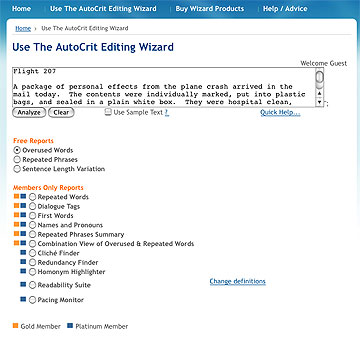
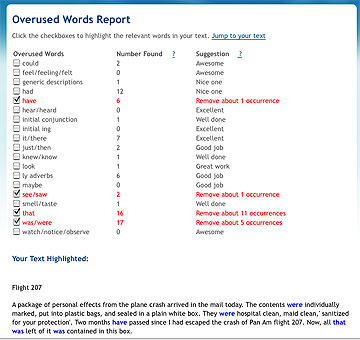
I stumbled across the AutoCrit site today and found it to be a helpful tool for editing your flash fiction stories. The free version allows you to paste a story of under 800 words into a text box, where you have the option of selecting reports on three categories: Overused Words, Repeated Phrases, and Sentence Length Variations. These categories are crucial to analyze when crafting a flash piece. So, I dug out an old story and pasted it into text box here: https://www.autocrit.com/autocrit/wizardformpage.php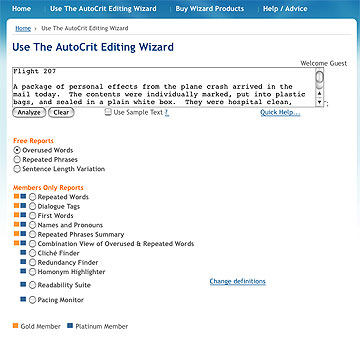 I clicked the "Overused Words" button and clicked "Analyze." The next screen shows a list of typically overused words with red check marks pertaining to your story, as well as suggestions for how many words to remove. I definitely used "that" too many times--which is a common mistake *that* (delete!) I see a lot in flash fiction, and a bad habit of mine. In most cases, you can safely remove "that"--it doesn't add anything to the sentence--and will help trim your word count. The AutoCrit said my use of "ly adverbs" was "Excellent," as was my use of "could," "it/there," and "maybe." Other interesting areas are the use of generic descriptions (I got a "Nice one" response), the use of feel/feeling/felt (I got a "Yay"), initial conjunction ("Well done"), and initial ing ("Nice work"). The comments are encouraging and are all wonderful helpers to fix passive voice problems. 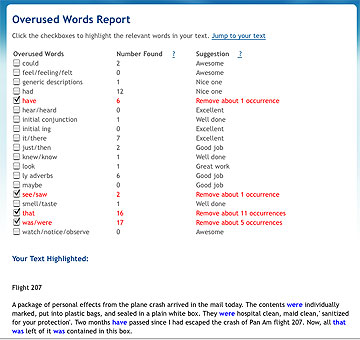 Beneath the checklist is your highlighted text with culprits displayed in blue. Drag your cursor over the text and copy-paste it into your MS Word program--you'll notice the blue text copies as well. At least it did with mine. You can only select one option at a time but you can hit the back button after you've read the results and your text will still be there. Then you can select one of the other options, such as "Repeated Phrases" and "Sentence Length." Repeated Phrases: This page shows all phrases which repeat within 100 words in highlighted blue text. If you are using a repeated phrase for emphasis it can be very powerful, but remember it should contribute something to the story, so use them carefully. When in doubt, leave it out--especially in flash. It will only eat your word count. Sentence Length: This page gives you a list of the beginning of each sentence and how many words it contains. It's important to vary your sentence length because similar-length sentences can be dull to read. The AutoCrit site offers further services to those that subscribe for a fee. I haven't tried their paid services, so I can't offer a review. Their "Members Only" reports include other editing tools such as: Dialogue Tags, First Words, Names and Pronouns, Cliche Finder, Redundancy Finder, Homonym Highlighter, Readability Suite, and Pacing Monitor. But I found their free online tool to be quite helpful in trimming unnecessary words and a good reminder to really check your story for any issues you might have missed. So if you're preparing to enter the WOW! Women On Writing Flash Fiction Contest, you may want to test your story with this helpful little tool before you hit the send button. Happy writing! Labels: AutoCrit, editing flash fiction, free critique tool for flash fiction, overused words, repeated phrases, sentence length
Martha Katzeff, Fall '09 Flash Fiction Contest Runner Up
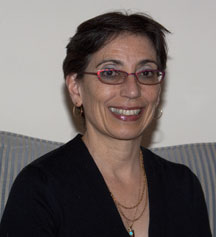
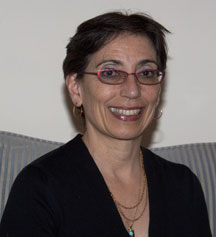 Martha Katzeff Martha Katzeff is very excited to have her first submission to a WOW! contest be among the top ten finalists. She has been writing for several years and takes classes at the Gotham Writers’ Workshop. She wrote an essay for Masters Cycling called “My Clown Bike” about her hot pink bicycle and recently had a piece of flash fiction titled “The Farm” published in 365 Tomorrows. Martha swims competitively with a Masters Swim team and wrote an essay about being a slow competitor called “Life in the Slow Lane” for the USMS website. She is married with two grown children, lives in the Bronx and likes to knit, read and travel. interviewed by Marcia Peterson WOW: Congratulations on placing as one of the Runners Up in our Fall 2009 Flash Fiction contest! What inspired you to enter the contest?Martha: I have a good friend who is also a relatively new writer and we're both always looking for contests to test our skills and storytelling abilities. I like the challenge of competing against other writers in a contest. It levels the playing field. WOW: Could you tell us a little about your story and what encouraged the idea behind “Get a Fresh Killed Chicken?" Martha: I initially entered a contest open only to Bronx writers and I wrote a memoir about shopping with my grandmother and mother. When I didn't win that contest, I re-wrote the story as fiction, throwing in a little bit of a speculative fiction/ghost story twist to it. WOW: Great idea to play around with the story—it worked out well for you. Since you've taken several writing classes, we'd love to know which ones have been your favorites and why?Martha: My favorite writing classes have been through Gotham Writers' Workshops. I started with Science Fiction I and moved to Science Fiction II which I've taken a few times (online). The instructor for most of the classes has been Michaela Roessener—the author of several wonderful science fiction/fantasy novels. She's very encouraging and loved the idea that one of her homework assignments morphed into this prize winning story! Science Fiction (or speculative fiction as it's called now) allows me to express my outrageous opinons through fiction in a way that mainstream fiction does not. In sci fi, there are unlimited worlds and experiences to write about. WOW: It's always interesting to learn about other people's writing routines. Could you tell us when and where you usually write? Do you have favorite tools or habits that get you going?Martha: I'll probably get into trouble for this, but I do most of my writing at work. Whether for better or worse, I have a low stress job with lots of down time. (I will absolutely not divulge where I work!) Sometimes I write on Sunday while my husband is watching some sporting event. I like the distraction—it helps me think. I wish I did have favorite tools or habits that get me going. I'd write more. That's why I like taking classes—it’s good impetus to keep going. WOW: Too bad you can’t tell us where you work! I agree that taking writing classes is a great way to force yourself into action. Finally, is there if there was one bit of advice you could pass on to other aspiring writers, what would it be?Martha: Don't get discouraged by negative criticism. Recently I was told that a story I'm writing isn't really Science Fiction, to which Michaela replied: give 'em the old Bronx cheer! Ignore unhelpful critiques and keep writing! ************ Check back on Tuesdays for more contest winner interviews.Labels: Fall 2009 Flash Fiction Contest, Flash Fiction Contest, Martha Katzeff, Runner up, Science Fiction, speculative fiction
|